Saturday, 21 January 2012

Subtitles: reduce, re-use, recycle? and a forthcoming seminar

A useful-looking seminar on subtitling this week at Imperial (wish I could go) which might well be of interest to students taking our subtitling module this semester: 

Date: Wednesday, 25th January 2012 
Time:  5-6 pm 
Room: Sherfield Building, Room S303A/B, Humanities Department.


Understanding and solving the AVT challenges presented by access subtitling
Andrew Lambourne CEO, SysMedia Ltd

Talk outline 
AVT in the context of subtitling presents a number of challenges due to the need to transform rich information from the aural and televisual domains into the more limited domain of written timed text. The cognitive processing involved in appreciating a multimedia presentation in its original form is significantly modified if the channel for acquisition of dialogue and (in the case of subtitling for deaf people) other cues is switched partially or totally from the ears to the eyes. The AVT task becomes more than just translation – it is also a form of interpretation, and the goals and objectives need to be clearly understood before it is possible to start to appreciate how the factors affecting success or quality might be recognised. When the scope of challenges is appreciated and prioritised, an approach can be taken to establishing guidelines and techniques which will best serve the intended users. Understanding what the audience needs is crucial to good subtitling. Once this is done, the next challenge is how to prepare the subtitles economically and effectively for different types of programme – live, fast-turnaround, recorded, DVD. We will look at some of the technologies and techniques which form part of the current and emerging systems and approaches.
 

Biography 
Andrew Lambourne has been working as a researcher, developer and visionary in the field of subtitling preparation systems for over 30 years. His early work at the University of Southampton pioneered many of the techniques which are still used in live and offline subtitling, and since then with his company SysMedia he has continued to push back the frontiers of what is achievable, with new versions of the WinCAPS system being launched at each technological step-change. This technical understanding is informed by a clear appreciation of the needs of the audience as well as knowledge of the commercial pressures which impact the industry. As a result he brings a “real-world” practicality to bear on this challenging AVT field.

More seminars at Imperial here. They are free and open to all. 


Blog post: subtitles past their sell-by date: 

For readers who are interested in subtitling and read French, there's an excellent post on one of my favourite translation blogs, Les piles intermédiaires, about the dangers of re-using existing subtitles. It sounds like good business sense (why re-invent the wheel, after all?) but these subtitles may be more trouble than they're worth. They may date from decades ago. They may fall short of today's quality standards, have old-fashioned language and may leave a lot of the dialogue out because subtitles used to condense dialogue much more aggressively. The post, entitled 'Du vieillissement (ou : vous n'emporterez pas vos sous-titres avec vous)' gives a funny and thorough analysis of the deficiencies of one set of French subtitles for You Can't Take It With You.

So, an area where recycling may not necessarily be a good thing. 

But nor is waste! I will admit to a great fondness for watching films with 'vintage' subtitles, for all that they can be harder to read because there's no dropshadow, they are sometimes oddly positioned on the screen, and they can have various typographic eccentricities. Maybe it's the fonts.... Somehow vintage fonts seem to have more charm than today's digitally-produced subtitles, as in these examples from Le jour se lève (from a late 70s US Videoyesteryear VHS cassette but look to me as though they are from the 1930s): 
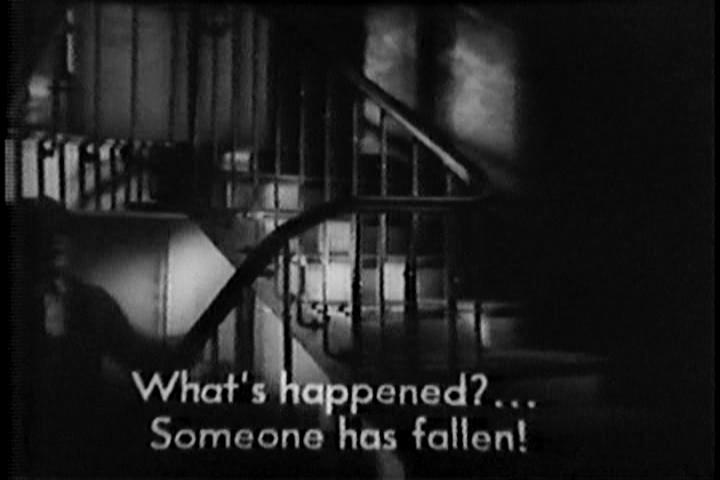


It's a real pity that archives often aren't in a position to preserve multiple subtitled copies of films. Ironically, with all the brilliant work that Criterion, Masters of Cinema etc. do, the 'new improved subtitle translations' deliberately 'overwrite' previous translations which may be of interest in their own right. The only place I know of where alternative DVD subtitles are routinely acknowledged is DVDBeaver, and that's only in passing. Very few DVD releases mention the film's prior translations (though Criterion's Region 1 release of Kurosawa's Throne of Blood and Persona in the Tartan DVD Bergman Collection are two honourable exceptions).

Wouldn't it make a great DVD extra to include a copy of the first subtitled print of a film, with all the inevitable imperfections, as an extra feature for new re-releases? This would be especially interesting for films released in the late 20s and early 30s when subtitling was still in its infancy. Rather than buying into some fantasy of the film in its original, pristine state 'as the director intended', it might make a useful point about the ways that audience expectations and translation conventions have changed over the decades.

More vintage subtitles, please!

Friday, 13 January 2012

Fun things to do in 2012: enter a translation competition

It will come as no surprise to my nearest and dearest that I have merrily broken most of my 2012 resolutions already; for stronger-minded readers of this blog who are still looking for suggestions for self-improvement in 2012, here's one that you might fancy:

 2012: enter a translation competition. 

There are lots of them out there, and they focus the mind marvellously. Some have set texts; some are open to any eligible text chosen by the translator. Prizes may include cash and/or publication. Good experience for entrants, and great exposure for prizewinners. Entry fees and restrictions on residence/nationality, etc. may apply. Information believed up-to-date at time of writing (though translation competitions do tend to wax and wane a bit).

Here are a few notable ones, roughly in order of deadline (click on links for terms and conditions):


New Books in German Emerging Translators Programme (deadline: 20 January 2012)
DE-EN. Six places available for translators who have not yet published a book-length translation. Involves a workshop in March and publication in New Books in German. Entries include a short sample translation; text is on the website.

German Embassy Award for Translators (deadline 31 January 2012)
DE-EN. Entrants translate a downloadable extract from the novel Das Geschenk by Wolf Wondratschek.

Modern Poetry in Translation Poetry Translation Prize (deadline 1 February 2012)
Open to translations into English of poems from any language on the subject of 'Freedom', not longer than 20 lines.

Dryden Prize (deadline 15 February 2012)
A long-running competition for unpublished literary translations from any language into English, organised by the BCLA and the BCLT.

Susan Sontag Prize for Translation (deadline 9 March 2012)
PT-EN. A different source language is chosen each year; this year it's Portuguese. For proposals rather than completed translations. The prize is a grant of $5,000 towards the proposed translation.

Academia Rossica Young Translators' Award
RU-EN. The translator chooses one of the set texts. Last year's deadline was in March. (The website is a bit difficult to extract information from).

The Times Stephen Spender Prize for Poetry Translation (deadline Friday 1 June 2012)
For poems from any classical or modern language into English, plus a short commentary on the translation. Three age categories: open, 18-and-under, 14-and-under.
Last year the Trust also inaugurated a Russian-to-English poetry translation prize, the Joseph Brodsky/Stephen Spender Prize: no details about a new deadline for this on the website as yet.

American-Scandinavian Foundation Translation Prize
For unpublished translations into English of Scandinavian writers born after 1800. Last year's deadline was in early June. 

Harvill Secker Young Translators' Prize
A different language is chosen each year (Spanish 2010, Arabic 2011, ?? 2012). Open to young translators from 16 to 34. Entrants translate a set text. Last year's deadline was in late July.

Translators' House Wales Translation Challenge
Translators' House Wales seems to run intermittent translation competitions from Welsh and other languages:


Austrian Cultural Forum Translators' Prize (entries accepted 1 July-1 September annually)
DE-EN. Gives a $3,000 grant, payable on acceptance of the full manuscript by a publisher, for an unpublished translation of an Austrian writer. North-America-focused.

Kurodahan Press Translation Prize 
JP-EN. The set text is usually announced in June, for a deadline in September.

Willis Barnstone Translation Prize
For unpublished translations of poetry from any language to English. Last year's deadline was in early December. 

William F. Sibley Memorial Translation Prize
JP-EN.  Literary translations, length not to exceed 15,000 words, eligible genres change year by year. No deadline available yet for 2012.

Alternatively, if you're more of an armchair translation-fancier, you could get involved by recommending an already-published work for a translation award; my favourite award which is open to nominations by civilians is the Science Fiction and Fantasy Translation Awards, a great initiative to win more recognition for genre fiction in translation.

If you're anywhere in the EU, and you are in contact with secondary schools, you might like to make them aware of the excellent Juvenes Translatores competition run annually by the Directorate-General for Translation of the European Commission.

For other lists of prizes, see here, here or here. I'd be delighted to hear further suggestions about translation prizes (especially into languages other than English) and links in the comments.

EDIT Tues 17 January:

ATA Student Translation Award (deadline 29 June 2012)
Have just heard about the American Translators' Association Student Translation Award, open to registered students in the United States (preferably registered on a translation programme).

EDIT Wednesday 25 January:

Compass Translation Award (RU-EN), deadline 25 June 2012
RU-EN Translate a poem of the entrant's choice by Marina Tsvetaeva.

UPDATE 22 JUNE 2012: For a fuller update on translation competitions, e.g. confirmed entry dates, etc. see http://matsnews.blogspot.co.uk/2012/06/translation-competitions-update-and.html.

Thursday, 12 January 2012

Translation seminars at Roehampton and elsewhere

Have just heard about some very interesting translation seminars run by the Centre for Translation and Transcultural Studies at the University of Roehampton:


Monday 16th January 4.30-5.30 7-8 pm Room QB 143
Aileen Cowan (Education Officer at the Institute of Translation and Interpreting)
“Introducing the ITI”

Thursday 2nd February , 5.30-6.30 pm Room QB 253
Dimitris Asimakoulas (University of Surrey)
"Dude or Lady Transsexual Identities in Subtitles'"

Wednesday 15th of February 7-8 pm Room QB 143
Anna Matamala (Universitat Autonoma, Barcelona)
“Research Topics in Dubbing and Voice Over: the past… and the future”

Wednesday 15th of March, 7-8 pm Room QB 143
Aline Remael (Artesis University, Antwerp)
“Audio-description with Audio-subtitling: dealing with multilingualism with Dutch films”

Lectures to take place in the Queen’s Building, Roehampton University, Roehampton Lane, London SW15. All welcome. 
For information, contact Lucile Desblache at l.desblache at roehampton.ac.uk.


There are also open seminar series run by the Universities of Manchester, Edinburgh and Heriot-Watt and by Imperial College. Would love to hear about other open seminars and events in the comments.

PhD funding at Imperial College

AHRC Funding Opportunity: Doctoral Studentship

The Translation Group at Imperial College London invites applications for a 3-year doctoral studentship funded by the AHRC to begin in October 2012.

Research in Translation Studies at Imperial College is carried out in a vibrant environment. Members of staff of the Translation Group are highly research active, and the Group is home to many PhD students conducting doctoral research in areas such as translation studies, translation technology, localisation, audiovisual translation and accessibility to the media. The Group nurtures a subject-specific research culture by scheduling research seminars, inviting guest speakers from the UK and abroad, welcoming academic visitors who wish to spend periods of research at Imperial College, and organising seminars, colloquia and conferences at our institution and other venues.

For further information about the Translation Group research, visit: www.imperial.ac.uk/humanities/translationgroup/ourresearch.

Studentship Award
Standard tuition fees and a maintenance grant will be paid by the AHRC for three years. For 2011-12 the maintenance grant for students in London was £15,590. EU candidates are normally eligible for a fees-only award, unless they have been ordinarily resident in the UK for 3 years immediately preceding the date of the award.

Eligibility
In line with research council requirements, applicants must meet UK residency criteria or be ordinarily resident in the EU. Applicants should hold a first or upper second class degree, and hold or be studying for an MSc or MA degree in modern languages, translation, or in another relevant area related to Translation Studies. Applicants should also fulfil Imperial College English language requirements, and be supported by two strong academic references. Further details concerning eligibility are available via the AHRC website at:
(pages 39-46).

How to apply
Applicants are invited to suggest their own topics of study, within the field of Translation Studies and submit a fully developed proposal. They are advised to contact a prospective supervisor to discuss their interests. For research interests of staff and of recent and current doctoral students, please visit:

Applicants should send the following documents to Tom Barbanneau at t.barbanneau at imperial.ac.uk by 19th March 2012. Please note that all documentation is required in English:
  • A research proposal including information about the research background/context, research aims and questions, methodology, any required resources and/or sources, and accompanied by a complete bibliography. The following document provides some advice on how to write a PhD proposal.
  • Curriculum Vitae.
  • Two academic reference letters.
  • A supporting statement of academic interests and reasons for applying for this studentship. This statement should also include details of academic achievements and any relevant research experience.
The deadline for applications is 19th March 2012. Interviews will be held at Imperial College soon after the deadline. For enquiries, please contact Dr Rocío Baños-Piñero at r.banos-pinero at imperial.ac.uk.

volunteer translators sought for Books Beyond Words

From the latest ITI Bulletin:

Baroness Coussins, Chairman of the All-Party Parliamentary Group on Modern Languages, in which ITI participates, has let us know that her fellow cross-bencer, Baroness Hollins, Professor of Psychiatry of Learning Disability at St George's, University of London, runs a social enterprise called 'Beyond Words', which produces picture books for people with learning disabilities who are facing traumatic or troubling times, e.g. the death of a parent.
The books are published jointly with the Royal College of Psychiatrists and St George's Hospital. At the back of each book is a section of text directed at the health care professionals, parents and carers who will be using these books. There are 25 books in the series and each includes 2-4,000 words of text. The language is simple and straightforward.
In order to meet the needs of non-English speakers, Lady Hollins would like to produce these books in Spanish, Russian, Japanese and Hindi; volunteers working into other language would also be most welcome.
If you are willing to work on a pro bono basis, please get in touch with: hollinss at parliament.uk, mentioning APPG as the source of this information. Companies or foundations are also sought who may be able to provide grant aid.
The translated books will benefit relevant communities in the UK and also be promoted in overseas markets.

Sunday, 8 January 2012

Two post-doctoral positions

Two posts for post-docs, seen advertised today. Neither is strictly speaking for translation studies but could be of interest to translation studies researchers with the right profile:


Research Associate: Intercultural Communication

University College London - European Languages

Part Time : 21.9 Hours per week (60% FTE)

The appointment will be on UCL Grade 7. The salary range will be £31,905 - £38,594 per annum , inclusive of London Allowance.

Applications are invited for a Research Associate to work with Dr Claire Thomson on an Intercultural Communication project, which is attached to the UCL Knowledge Transfer Champion initiative. This will involve undertaking a research project investigating effective design and modes of delivery of Intercultural Communication in the context of Continuing Professional Development (CDP) for Small and Medium Enterprises in the local Tourist Industry.

This post is funded for 7 months and will start as soon as possible in January 2012 (specific dates to be confirmed).

Applicants should have near-native-speaker proficiency in at least one modern foreign language and hold (or be in the process of writing up and submitting) a PhD or equivalent qualification in a relevant field. Experience of teaching modern foreign languages in a Higher Education context is essential, as is knowledge of current scholarship on the relationship between cultural identity and language. Experience in the tourism sector would be advantageous, as would knowledge of enterprise, knowledge transfer or public engagement within a university context.

For further details about the vacancy and how to apply on line please go to http://www.ucl.ac.uk/hr/jobs/ and search on Reference Number 1223972

***

Mellon/Newton Postdoctoral Research Fellowships

University of Cambridge - Centre for Research in the Arts, Social Sciences and Humanities

Salary: £27,428 - £35,788 pa

Limit of tenure: Appointment is fixed term for two years and is non-renewable.

Applications are invited for two 2-year interdisciplinary Post-doctoral Research Fellowships starting in October 2012 and based at CRASSH.  The programme, funded jointly by the Mellon Foundation and the Isaac Newton Trust, is aimed at researchers working in any field of the arts, social sciences or humanities. The fellowships will enable post-doctoral fellows to consolidate their research and publication record while developing a related project or initiative at CRASSH during their two-year fellowship.

For further details of the post, please see the CRASSH website, http://www.crassh.cam.ac.uk/page/1084/call-for-applications-2012.htm

Quote Reference: VM11412
Closing Date: 2 March 2012
Interview Date(s): Week of 24 April 2012