Showing posts with label subtitling. Show all posts

Thursday, 17 January 2019

Upcoming translation events at Bristol

It's been a while since I've updated the blog, but just popping in to say we've got three events coming up at Bristol later this month and next month which may be of interest to readers:

1) Postgraduate Research Study Day

28 January 2019, 2-5.15 pm, in G4, 3 Priory Road.

Some of our PhD students in Translation Studies will be presenting their work, followed by drinks and nibbles in the School of Modern Languages, Common Room, 17 Woodland Road.
Enquiries to adrienne.mason at bristol.ac.uk.

2) Translation pricing event (N.B. translation students only)
Thursday 31 January 2019 
1715-1900, Room G4/5, 10 Woodland Road, Bristol BS8 1UQ 


Registration at:
https://www.eventbrite.co.uk/e/translation-pricing-tickets-53683091572

This is a hands-on translation pricing and quoting workshop jointly held by the University of Bristol and the Western Regional Group (WRG) of the Institute of Translation and Interpreting. Students will get first-hand advice from experienced WRG members who will discuss pricing strategies based on situations they encountered throughout their career. There will be plenty of time for networking over refreshments. Attendance is free but registration is required. Translation students from any institution may attend.


3) Subtitling Masterclass with Professor Luis Pérez González

Thursday 14 February 2019
2-4pm, G10, 43 Woodland Road, Bristol BS8 1UU.

In collaboration with Migrating Texts, we are delighted to present Professor Luis Pérez González of the University of Manchester. As part of our Subtitling Masterclass series, he will present on

Immaterial Subtitling in the Digital Culture Value Chain:

Implications for Subtitle Reception Studies


This event is free and open to all.
More details and a link to register here: https://www.eventbrite.co.uk/e/migrating-texts-subtitling-masterclass-2019-tickets-54303182280

We hope to see you there!

Thursday, 17 May 2018

Why typography is important in subtitling

"Well, I'm back," she said.

I'm thinking about a paper I'm writing for the conference Beyond Words: Multimodal Encounters in Translation, which will take place in Cambridge in July 2018.

Part of the paper will talk about meaning-making in typography and specifically in film intertitles and subtitles. (I've said something about this before here)

Now I have come across this splendid fansubtitled video about Thranduil and the gems of Lasgalen, from Peter Jackson's Hobbit adaptation. Every character gets a different subtitle typeface:


So, two questions:

1) Which typeface is best suited to its character? Answers in the comments please. 
2) Which can you actually read without eyestrain? The video is shooting for accessibility, which is always a good thing, but the typefaces are not, really.

And if readers out there want to rank the typefaces in order of most to least accessible, I'm all ears! 

Tuesday, 9 May 2017

Lecture in Leicester by Luis Pérez-González, 'Researching Audiovisual Translation Outside the Margins of the Frame', 18 May 2017

This looks like a great event: am sorry that I won't be able to be there, but in case any readers of this blog are in hailing distance of Leicester: 

The Centre for Translation and Interpreting Studies at the University of Leicester is pleased to announce the 2017 Annual Lecture

Beyond Representation: Researching Audiovisual Translation outside the Margins of the Frame

Professor Luis Pérez-González
Centre for Translation and Intercultural Studies
University of Manchester

Venue: Council Suite Room One, First Floor, Fielding Johnson Building, University of Leicester

Time: 6-8pm Thursday 18 May 2017, including a drinks reception

This session problematises the role that representation has played as the driving logic of mediation behind industrial approaches to audiovisual translation during the mass media culture – characterised by the centrality of tele-cinematic commodities, the prevalence of linear models of media consumption and distribution, and the mapping of audiovisual markets onto discrete national audiences. In the post-industrial digital culture that began to crystallise a decade ago, the means of media ‘prosumption’ have become more entangled and collaborative, and brought to the fore ‘the bottom-up energy of media created by amateurs and hobbyists as a matter of course’ (Blau 20015: 3). Against this backdrop, the portability and reproducibility of media content is reshaping the media marketplace: with streaming on-demand channels of transmission becoming more ubiquitous, audiences are becoming rapidly superseded by much more fragmented and fluid ‘audienceships’ (Pérez-González 2014). Significantly, for the purposes of this session, the networked dynamics of the digital culture are favouring intervention as an alternative approach to linguistic and cultural mediation that erodes the privileged status of the original text and allows for new forms of interaction between translators and their audienceships.

Under this new interventionist regime, scholars interested in the sociology of audiovisual translation are presented with new research challenges and opportunities. In this session, I will examine how audiovisual translation is quickly emerging as a community-building cultural activity, which calls for the analytical lens to be shifted away from the translation output towards the processes of organisation and deliberation that take place around this participatory activity and contribute to galvanising geographically dispersed collectivities of interest. Specifically, this presentation explores the theoretical and methodological demands that these developments place on audiovisual translation scholars, and surveys a range of frameworks that could assist us in harnessing the complexity of audiovisual translation activities in the digital culture.


Luis Pérez-González is Professor of Translation Studies and Co-director of the Centre for Translation and Intercultural Studies at the University of Manchester, UK. He is a Co-investigator on the 4-year project Genealogies of Knowledge: The Evolution and Contestation of Concepts across Time and Space, and a case study analyst in the Manchester-led OWRI project Cross-language Dynamics: Reshaping Community – both of them funded by the Arts and Humanities Research Council in the UK. He is also author of Audiovisual Translation: Theories, Methods and Issues (Routledge 2014), editor of Routledge Handbook of Audiovisual Translation (2017), and co-editor of Routledge’s Critical Perspectives on Citizen Media book series. His articles have appeared in a wide range of international journals, including The Translator, The Journal of Language and Politics, Convergence: The International Journal of Research into New Media, International Journal of Cultural Studies, Journal of Pragmatics and Language and Intercultural Communication.

The event is open to all. For further information contact Dr. Anna Milsom at a.milsom [at] leicester.ac.uk.

Tuesday, 3 January 2017

An Odd Adventure: New Year's musings on subtitles from 1932

Regular readers of this blog or of my Twitter feed will know that I'm working on the history of subtitling. As a happy new year greeting to all three of my faithful readers, here's a short piece from Edwin Schallert of the Los Angeles Times, published on 2 January 1932, a few months after subtitles had begun to appear in the United States (previously audiences had either had to speak the language in question, or make do with a synopsis in the programme).

They were called 'superimposed titles' to differentiate them from intertitles, which were interpolated between moving picture footage, rather than superimposed. Intertitles were referred to at the time as subtitles, to add to the confusion. Reading the rather plodding explanation below, we should remember that these were viewers used to silent films, where the action had to stop when a title card appeared. The idea of a title running concurrently with the action was a bit revolutionary:

Superimposed Titles
Witnessing a picture with superimposed titles, so-called, is an odd adventure. Superimposed titles are explanatory subtitles printed on scenes in the film, which translate the purport of what is being said in another language. They are being used in Europe on the American pictures. The words spoken in English are those translated into German, French or some other language, depending on what country the picture is shown in, so that its dialogue may be understood by the audience.
   I saw the French film, 'David Golder,' with superimposed German titles, and a knowledge of that language made it exceedingly easy to folow. The words spoken in French, which is often a difficult language to understand conversationally, acquired meaning as the picture progressed. It would seem, therefore, that the viewing of pictures with superimposed titles is an aid in acquiring a knowledge of a different tongue. Nor is it as complicated nor as distracting a method of witnessing a picture show as might be imagined.                      (2 January 1932, p.19)

Harry Baur, as David Golder (Duvivier, 1931) with his horrible daughter Joyce, played by Jackie Monnier


As a bonus extra feature on this blog post, here's a snippet by Harrison Carroli a few months later in the Evening News of Wilkes-Barre, Pennsylvania:

A superimposed title, in case the term leaves you with a blank feeling, is the old-fashioned silent title cut down to a narrow strip and imposed across the bottom of the image on the screen. In Japan it's a perpendicular strip along the side. This title translates or explains the English dialogue, which goes on without interruption.(22 April 1932, p.9)

Wednesday, 2 November 2016

Lecture by Professor Mona Baker, Bristol, 10 November 2016


We are really excited to welcome Professor Mona Baker, Emeritus Professor in Translation Studies from the University of Manchester, who will give a lecture on:

Fluidity, Uncertainty and Distance: Researching Volunteer Subtitling in the Context of the Egyptian Revolution

Thursday 10 November 2016
5.15pm - 6.30pm
Lecture Theatre 3, 17 Woodland Road (entrance for non-university members via 3-5 Woodland Rd)
Entrance is free and all are welcome.

Abstract
While interest in volunteer translation and interpreting has grown noticeably in recent years, little field work has been undertaken to examine this important form of citizen media practice in violent and high risk contexts. Drawing on a recent study of the collaboration between subtitlers and filmmakers during the 2011 Egyptian Revolution, this presentation will focus on the challenges posed by a fast-paced, fluid, non-hierarchical context of collaboration between relatively distinct groups (filmmakers and subtitlers) who do not interact regularly despite producing prolific output collaboratively. The discussion will also explore the difficulty of offering traditional research ‘findings’ in contexts where intense human relations and experiences are unfolding and taking unpredictable directions during the research period, rendering any notion of optimal researcher distance from the object of study both unworkable and undesirable and placing issues of trust and ethics at the centre of the research agenda. These difficulties are further exasperated by the ethos of contemporary movements of collective action, where there is often no interest in maintaining a record of individual contributions to any output or even a basic hierarchical structure that prevents any member from editing a (subtitled) video after it has been published.

More information at http://www.bristol.ac.uk/arts/events/2016/november/fluidity.html

She's a fantastic speaker, and we hope to see some of you there!

Monday, 8 August 2016

Subtitling 'Du' and 'Sie'

I was just watching Michael Verhoeven's 1990 film Das schreckliche Mädchen [The Nasty Girl] and I was struck by this exchange between the protagonist Sonja and her crush Martin, a trainee teacher.
MARTIN: Wenn ich mein Staatsexamen hab' komm'ich zurück zu dir...vielmehr - zu Ihnen. [Pause.] Wollen wir nicht Du sagen zueinander?
SONJA: Doch, schon.
MARTIN: Ich heiß' Martin.
SONJA: Weiß schon...
Translating the shift from formal to informal address, which is standard in many languages but somehow not in English, is always tricky. (And not just in subtitling either. For a great discussion about this, sparked by an ingenious solution of Ros Schwartz's, see this languagehat post.)

A rough translation of Martin's remark would be something like: When I pass my state teaching exam, I'll come back to you [informal]...or rather [correcting himself] - to you [formal]. [Pause.] Can't we address each other as you [informal]?.

Multimodal elements of this scene will have to be taken into account. Kinetics, mise en scène, sound and rhythm may reinforce, undercut or otherwise inflect what's happening with the dialogue. A distinct change of mood occurs when Martin sees Sonja's secret framed photograph of him. He takes off his glasses. The scene opens with him standing while she sits. When he catches sight of the picture he crouches down to see better. She stands up so that she is momentarily taller than him; he stands and is again taller than her. His face is surprised, then serious; hers is quizzical. There's a short pause before he corrects Du to Sie and then a longer pause before he suggests that they call each other Du. All these things contribute to how the scene signifies, and may act as a guide (consciously or intuitively) to the subtitler.

Obviously, English uses the same word for both Du and Sie, so if transposed directly Martin's self-correction would make no sense, and there is no corresponding English expression for the question abut using Du.

The subtitler of this clip on the Miramax Youtube channel solves the problem as follows:


The subtitler changes the emphasis of Martin's line. Instead of correcting himself, he starts by saying that he will come back (implied, to the school), and then corrects himself that he will come back to her, specifically. You can see the whole clip here (it's at 2 mins 24 secs):


My 1992 VCI videocassette edition has, presumably, a different (unnamed) subtitler, and a different solution. The subtitler in fact has done the opposite of what the Miramax subtitler did:


This solution actually fits more closely with the dynamic of this scene, since he moves from a more intimate register (back to you) to a more 'formal' register in that 'to all of you' re-situates her as just a girl in his class. The long pause gives him time to gather his courage to request that they start using Du (and, by implication, that they begin a romantic relationship). The rather awkwardly formal 'Shall we be on Christian-name terms' is not out of keeping with the film's register.

So, a nice example of how opposite approaches by two translators can both work, in the moment.

More on translating formal and informal address, in a future post. Meanwhile if anybody has a copy of this film to hand, in any language, with a different subtitling solution, I'd love to hear about it.

UPDATE 20 August 2016: I rewrote and extended this post because on re-viewing the clips I realised I'd missed a couple of important things. (That will teach me to blog late at night.)

UPDATE 24 August 2016: The wonderful 20th-Century Flicks in Bristol turns out to have yet another subtitled version of the film, distributed by Arrow on Region 2 DVD (dated 2005). It has quite a different take on this scene again. The subtitles are by Lotti Mardell and Peter Templeton for SBS Australia, dated 2002:


This solution works very well to get across the levels of formality, though there's a lack of correspondence between the audio, where the proper names are not heard, and the subtitles. The trade-off seems worth it in this instance.

Any more versions out there...? Any information that might help me identify the subtitlers of the first two versions?

Tuesday, 19 July 2016

Early film translations: Marcel Carné on the first subtitled films in France

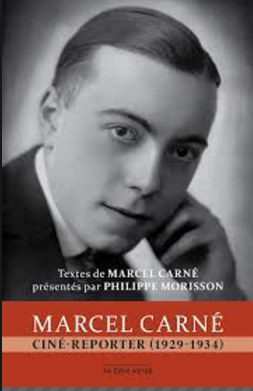
An excellent volume of Marcel Carné's film criticism has just appeared: Marcel Carné: Ciné-reporter (1929-1934), edited by Philippe Morisson and published by La Tour Verte.

One section, entitled 'Cet art qui fut muet et devint parlant: Articles sur les talkies' [That art that was dumb and became talking: Articles on the talkies], includes pieces published in Cinémagazine and other film magazines between August 1929 and April 1931, at the height of the transition from silent to sound films. Carné covers what it is like on a film set shooting a sound picture, discusses the technical requirements and skillsets required to shoot and edit sound film (at a time when the camera was just emerging again from its soundproof booth), and debates with Marcel Lapierre about whether silent film has, in fact, had its day.

One of the pieces, 'De l'internationalité du film parlant' ['On the internationalism of the talking picture'] published in Cinémagazine 48, 29 November 1929, gives a fascinating viewpoint on the development, and unpopularity, of subtitles in France. This is so relevant to my own research on film translation between the silent and the sound periods (see http://www.britac.ac.uk/events/2015/Splendid_Innovations.cfm) that I hope I will be forgiven for quoting it at some length. It is also cited by my colleague Dr Jean-François Cornu in his 2014 book Le doublage et le sous-titrage. Histoire et esthétique (Presses Universitaires de Rennes),

I have taken the liberty of putting a few particularly interesting phrases in bold, including the speculation that talking films might, like great books, one day have translators of their own (gosh!); and the condemnation that subtitling was a cognitive impossibility for audiences. The first of these statements is not false as such; but the low status of film translators relative to literary translators (see this post for more on this) makes it in some ways a slightly skewed prediction.

 The translation that follows, and any errors in it, are my own.
Le seul reproche - il est vrai qu'il est de taille - qu'on puisse adresser aujourd'hui au film parlant, est que du jour où le cinéma a trouvé la parole, il a cessé d'être un art international par excellence.
   Encore faudrait-il s'entendre là-dessus; le cinéma parlant est national au même titre que la littérature ou le théâtre. Et nous verrons tout à l'heure qu'il est fort possible que, d'ici quelque temps, le film parlé, produit d'une race, ait, lui aussi, ses traducteurs, tout comme un chef-d'oeuvre de la littérature ou une pièce consacrée dans son propre pays, par un succès éclatant.
   À l'origine des talkies, on imagina, pour tourner la difficulté, de sur-impressioner sur l'image des sous-titres explicatifs. Au début, la curiosité l'emporta: il nous suffit de citer le succès du Chanteur de jazz et de La Chanson de Paris. Pourtant, ce que les spectateurs toléraient pour les premiers films, ils l'admirent moins facilement par la suite.
C'est ainsi que Weary River, pour n'en citer qu'un, valant très largement les deux premiers, connut un succès honorable, certes, mais ne souffrant pas la comparaison avec ses deux devanciers. Encore plus que l'absence d'une très grande vedette (car Barthelmess, malgré son grand talent, n'a pas la célébrité d'un Chevalier), les nombreux sous-titres français intercalés dans Weary River ne furent pas étrangers à cet état de choses. Il n'est, au reste, pas une personne à l'heure actuelle qui n'ait compris que ce système n'est qu'un pis-aller qui ne saurait subsister bien longtemps encore. Outre que cela est fort désagréable, il est matériellement impossible à un spectateur de suivre à la fois le jeu parlé des acteurs et de lire les sous-titres inscrits dans le bas de l'image.
   Et puis n'est-il pas paradoxal que le film parlant, au lieu de supprimer les sous-titres comme on était en droit de attendre de lui, les multiplie, au contraire, à l'infini?
   Un établissement des boulevards n'annonce-t-il pas actuellement un film parlant américain cent pour cent parlant avec de nombreux sous-titres français; alors qu'une telle annonce eût fait fuir les spectateurs il y a seulement un an! Enfin, les lecteurs de cette revue n'ont pas été sans remarquer que le procédé de surimpression des titres nécessite, ce que l'on appelle en termes techniques, un contretype, c'est-à-dire un double tirage du négatif, ce qui a pour efet d'obscurcir singulièrement la photographie la plus lumineuse.
   Donc, à tous les points de vue, le système s'avérait détestable. Aussi, a-t-on cherché autre chose. Et la lumière nous est venue, cette fois, de l'Angleterre. [...]
My translation: The only reproach - though, to be fair, a substantial one - that could be directed today to the talking film, is that from the moment that cinema discovered words, it ceased to become the international art par excellence.
   Let us be clear: the sound cinema is national in the same way as literature or theatre are. And we will see shortly that it is entirely possible that, some time in the future, the talking film, as a national product, will itself also have its translators, just as a literary masterpiece might, or a theatre play which has been a major success in its own country.
   When talkies began, someone came up with the idea of solving the problem by superimposing explanatory sub-titles on the image. This passed muster with early spectators, as witness the success of The Jazz Singer and Innocents of Paris. But what spectators tolerated in the first sound films was less welcome to them as time went on. That explains why Weary River, for instance, every bit as good as the two earlier films, met with fair success, sure, but nothing like its two predecessors. This will have been partly due to the lack of a major star (because Barthelmess, while a very talented actor, has nothing like Maurice Chevalier's fame), but the many French subtitles in Weary River were also a factor. There isn't anybody, at this point, who hasn't realised that this system [subtitling] is nothing but a shabby compromise whose days are numbered. Apart from the fact that it is very disagreeable, it is materially impossible for a spectator to follow the actors' performances and to read the subtitles at the bottom of the image at the same time.
   And is it not paradoxical that the talking film, instead of suppressing titles as we might have expected, is instead proliferating them into infinity?
   Is a popular Paris cinema not currently advertising a 100 per cent talking American film with many French subtitles, though such an advertisement would have made spectators take to their heels only a year ago! And readers of this periodical have taken the opportunity to observe that the superimposition of titles on the image requires what is technically referred to as a contretype, in other words a duplication of the negative, the result of which is a noticeable darkening of even the brightest photographic image.
   So, on all fronts, the system has proven detestable. Another solution was sought. And the light came, this time, from England. [...]

(c) for the translation Carol O'Sullivan, 2016. Many thanks to Sam B. for picking up a couple of errors in the draft.

Sunday, 22 November 2015

Translating Rome, Open City

I went to a splendid showing of Roberto Rossellini's 1945 film Roma, città aperta on Friday night, courtesy of the Italian Department at the University of Bristol and the InsideArts festival. We saw a restored print with English subtitles credited to the festival Il cinema ritrovato, where the restoration was done.


The film is certainly not the version scorned by one denizen of Netflix for its "Operetta germans, heroic priests, magazine-cover kids, forced conversation, bad (frequently missing!) subtitles, video quality low (all the scratches, blotches, and dark areas are here, just like you're watching the old film)" (one does wonder if the subtitles and the print quality had been better, would the viewer have found the Germans operettish, the conversation forced, etc.)

The subtitles on this version were good and often funny, with smart and unobtrusive solutions for many very Italian turns of phrase. It made me wonder about the first English subtitled version of this film in the US, which opened, according to David Forgacs, on 25 February 1946 at the World Theater on 49th St., and ran there for nearly two years. It had subtitles by Pietro di Donato and Herman Weinberg. Herman G. Weinberg worked as a subtitler and film critic from the early 1930s to the early 1970s and pioneered subtitling in the United States; more on him in a future post, perhaps.

Are di Donato and Weinberg guilty of perpetrating the "bad and frequently missing" subtitles mentioned above? Bosley Crowther in the New York Times doesn't comment. I wonder what the local newspaper files of newspapers.com may be able to tell us.

The Winnipeg Tribune of Friday 18 April, 1947 closes a long review by naming and praising the subtitlers:


In a slightly later review on Tuesday 17 June, 1947, the Sandusky Register in Sandusky, Ohio, comments that
We do, however, get a hint in the Winnipeg Tribune review that these subtitles might have been the rather selective subtitles which were typical of the period. And lo, the Gazette and Daily, of York, Pennsylvania, on 11 February 1947 indeed had some reservations about the completeness of the subtitles: 


The subtitles must have really been quite bad to trigger this return to the 'transcending the limitations of language' shtick, so prevalent fifteen years previously. It looks likely that these subtitles may indeed be the ones referred to so bitterly by the disenchanted Netflixer above.

Interestingly, subtitles still seem to have been rather strange to a proportion of the film-going audience, or why does the Daily Times-News of Burlington, NC have to explain, on 12 July 1947, what subtitles are?:


But the award for the most comprehensive comment on the film's translation (or at least the most comprehensive that a evening's energetic keyword searching could provide) must go to a columnist on the Daily Tar Heel, student newspaper at the University of North Carolina at Chapel Hill, who has this to say on May Day 1947 (I give it in extenso, so that you get the full flavour):


Mr Allen expends much of his creative energies on describing the subtitles:


Setting aside the author's unendearing linguistic shtick, this review gives us a rather clearer picture of how selective Mr Weinberg's and signor di Donato's subtitles really were. It offers an intriguing research line to follow. How much was this viewer exaggerating the selectiveness of the subtitling? To what extent were other reviewers just grinning and bearing it - or, indeed, so riveted by the film's acting and storyline that they did not fully notice the subtitles? Only a close comparison against a copy of this version of the film can begin to tell us.

It becomes clear in the closing paragraphs of the review that Mr Allen's disappointment in Open City stemmed from the mismatch between the advertising and the product:


This seems to have been the kind of advertising that Allen was talking about: 

 From Samuel Wilson's excellent review at http://mondo70.blogspot.co.uk/2010/12/open-city-1945-and-foreign-film.html

Tino Balio's informative book The Foreign Film Renaissance on American Screens 1946-1973 has much to say about the way this film was marketed:
Realizing it would take time to cultivate an audience for foreign films, [the distributor, Joseph] Burstyn used venerable exploitation techniques to attract attention. [...] Although the New York Board of Censors passed the film "with but insignificant scissorings", according to Variety, Mayer-Burstyn decided to bypass the Production Code Administration (PCA) to avoid having to make further cuts. The same article continued: "Its got plenty to make [Hollywood censors] blanch if and when it is shown them. Principal sympathetic femme character speaks openly of her pregnancy, although she's not wed, and the traitoress who leads to the capture and death of the partisans betrays them for a combination of cocaine and the love of a lesbo German spy. That's just a sample of the angles for the PCA to mull, while the handling of the priest will no doubt make the Legion of Decency gulp hard, although the film has been okayed by the Vatican." Unlike the Vatican, the Legion of Decency found much to fault in the film and gave it a condemned rating. Lacking the Production Code seal and the C rating meant that Open City would not be booked by the major theater chains.
The Mayer-Burstyn partnership made the best of circumstances. First, it released Roma, città aperta, the original title of the film, as Open City. The original referred to Rome's protected status during the war as a historical city. Burstyn's title suggests something quite different - a wide-open city where anything goes. In line with this title change, Mayer-Burstyn promoted the film as "Sexier than Hollywood ever dared to be!" and ran ads with fake publicity stills, one showing "two young ladies deeply engrossed in a rapt embrace" and another of "a man being flogged", both of where were "designed to tap the sadist trade", according to Mayer. As Variety explained, two types of audiences existed for foreign films: the "fairly discriminating filmgoers", who were taken with the "raw, unvarnished approach to sex" in the films, and the "transients, the misfits...and the loose-jawed brethren" who normally got their thrills vicariously from exploitation films". At first Open City played in art houses and independent theaters. Mayer-Burstyn later toned down the torture scenes and removed an offending shot of a toddler on a potty to secure a coveted code seal and entrée to mainstream theaters. (pp.41-42)
There's much to mull over here, including the existence of multiple cuts of the film, and the questions that remain over which version of the film a given audience might have seen. I like very much Samuel Wilson's comment, in his review of Balio's book and the film, that the Burstyn-Mayer release is an important version (or, I guess, versions) in its own right, which deserved to be given greater prominence in the Criterion edition. In the same vein, I would argue that di Donato and Weinberg's subtitles, patchy as they were, are also a significant factor in the film's reception in the United States, and deserve to be represented, even in the form of a clip for purposes of comparison, on a future DVD. 

N.B. Post updated after publication to reflect the fact that di Donato and Weinberg's subtitles seem to be available in all their patchiness and elegance of typeface, on the TCM website


Post-post-scriptum: Updated once again on finding out from colleague and Italian film scholar Catherine O'Rawe that Pietro di Donato was in fact a somewhat well-known literary figure. There is an essay by Loredana Polezzi about his novel Christ in Concrete here.

Wednesday, 29 July 2015

Snippets from film translation history: the subtitle turners

Following on a very interesting paper by Rachel Weissbrod at the Splendid Innovations conference in May 2015 at the British Academy, where Rachel talked about the beginnings of film translation in Mandatory Palestine, I have been reminded by Sam B. of this story by Israeli film producer Menahem Golan, from an interview in Cinema Scope:


Cinema Scope: You became involved with movies as a child back in your Israeli hometown of Tiberias, when one of your first jobs was as a subtitle-turner.

 Menahem Golan: At that time the subtitles were not on the film, but projected on the side. So you needed someone to turn the wheel. And already as a child I wanted to see every movie, but my father didn’t give me the money to go to the cinema three or four times a week. So I made a deal with the projectionist that I would turn the film subtitles for free, as long as I could see the movie. But it often happened that I got so caught up in the film that I forgot to turn the wheel. And the whole cinema would start yelling: “Menahem! Menahem! Subtitles!!!”

UPDATE 21 August 2015: I have just come across this account on Luke McKernan's excellent Picturegoing blog by the Palestianian author Khalid Totah (1886-1955) of going to see Olivier's Hamlet and another unnamed Hollywood film in Damascus, probably in the late 1940s. There's just a brief mention of the subtitles: 'of course the film was in English, but on the side there was an Arabic translation'. This would have been a bit later than Golan's account - Golan was born in 1929, so was probably turning subtitles in the early 1940s. If any readers know of other accounts of this subtitling-on-the-side in the Middle East I'd be very happy to hear about it.

Saturday, 11 July 2015

"Sub-titles inept, sub-titles abominable": a Russian film in the UK, 1935

I made a long-awaited trip back to Southsea this weekend and popped in to my favourite bookshop in the world, Adelphi Books on Albert Road, where I acquired (among other trifles) some 1930s issues of Sight and Sound. The autumn 1935 issue contains a review by Arthur Vesselo of Petersburg Nights (Roshal & Stroyeva, 1934) (referred to in the review as St. Petersburg, known in France as Les nuits de Saint-Pétersbourg). (I note that the film was nominated in the same year for the Mussolini Cup for Best Foreign Film at the Venice Film Festival, but otherwise seems to have had an undistinguished career.)

(image borrowed from Encyclocine)

Vesselo isn't happy with the film, or the translation:
The film as a whole has little real solidity: its movements are feeble, its climaxes crude. The propagandist element lacks both purpose and subtlety, and the nineteenth-century setting is infinitely less convincing than the customary Russian treatment of present-day conditions. What virtue remains is ruthlessly massacred by the sub-titles.
   This question of sub-titles needs long and deep consideration. They meet us at every turn: sub-titles misplaced, sub-titles mis-spelt, sub-titles inept, sub-titles abominable. They throw out the composition of shots, ruin their photographic quality, and break up their continuity - sometimes they seem to swamp the picture completely. (Sight and Sound 1935, vol. 4, no.15, p.124)
There were very competent subtitlers working in London in this period - Mai Harris, Julia Wolf - so one suspects that these abominable sub-titles may have been produced in the country of origin - well, we'll see, if a copy can be tracked down in the archive.

It's worth noting by the by that Vesselo doesn't seem a big fan of dubbing either: in the same section he reviews a Czech film, Volga in Flames, and complains that the dubbed English dialogue
was hardly a success. the lack of correspondence between words and mouth-movements can be ignored, but the vast unsuitability of Western tone and accent is another matter. Cossacks and Cockneys have little in common; and at moments of tension the formal intonation of the studio reduces the action to bathos. Choice of language also provides its problems. Wherever, in fact, the dialogue ceased for a space to be predominant, and the film was left to rely upon its original sounds, the story was lifted bodily to a higher sphere.
Interestingly,  Vesselo doesn't note that the film was in fact dubbed from French (thanks to Sam B. for pointing this out) as the film was a French-Czech co-production with Danielle Darrieux and Albert Préjean, also known as Volga en flammes:


Tuesday, 19 May 2015

Adrian Brunel redux: on subtitling and dubbing in the early 1930s

I mentioned Adrian Brunel's autobiography Nice Work in a recent post, as he observed the transition from the silent to the sound period from close up. On reading further we learn that he also worked as a subtitler some time in the early 1930s.

It is not very promising that the chapter where he describes his work in audiovisual translation is entitled 'Slumming':
I picked up a few little interesting jobs titling foreign films - interesting as jobs but deadly dull financially. After having been paid £250 for titling a silent foreign film, the maximum I could get for doing a foreign talkie was £40. As I [...] naturally gave part of my fee to Roy Lockwood, Reggie Beck or whoever was assisting me, it was hardly worth our time after we had learned what we could of the job. One think I learned still applies to-day [at time of writing in the late 1940s] - that the super-imposition of translated titles is a neglected art, probably because it is very badly paid. Most foreign film so titled are spoiled by not having had enough time, invention and skill expended on grappling with the problem of condensing eighteen spoken words into six printed words, of finding just the right place to superimpose the title, of judging when no title is necessary, of how to avoid unnecessary overlapping of a title on to two scenes and so on. (p.162)
It's interesting to see how little the basics of subtitling have changed in nearly a century, though subtitles were sparser and more selective, still, at the time Brunel was writing. Brunel himself felt that dubbing was superior to subtitling: 'superimposed translations [were] disturbing', while 'with care, patience, time and intelligence, almost perfect results can be obtained' in dubbing. He was involved in dubbing the Guido Brignone film La Wally, made in 1932, but found that the translation did not go far enough:
we did a fine job [...] but unfortunately my detailed and urgently stressed advice on how to edit the film for England was ignored, so that it was ruined by the inclusion of several passages which I knew would be regarded as ridiculous by English audiences. (p.165)
If you are interested in hearing more about these problems of audiovisual translation in the early years of sound, you may still (just about) be able to register for our conference 'Splendid Innovations', which takes place this Thursday 21 and Friday 22 May at the British Academy, London:


Only two more sleeps until the conference! \o/\o/

Sunday, 1 March 2015

Missing the joke? Hellzapoppin! in translation

I'm excited about taking part in the upcoming 'Authors and the World' workshop in Lancaster on Discourses of Literary Celebrity Across Genres (see here for more information). I'll be talking about literary celebrity and subtitling, which are two things that don't really seem to go together.

Well, nearly never. Every now and then, a subtitler makes a name for themselves, like Mai Harris, Herman Weinberg, Linda Hoaglund or Lenny Borger. There is even the rare 'celebrity' subtitler like Anthony Burgess for Rappeneau's Cyrano de Bergerac. When the 1941 Universal comedy extravaganza Hellzapoppin was released in France after the end of the Second World War, it was advertised as a 'version originale sous-titrée par LES ROIS DES LOUFOQUES Pierre Dac and Fernand Rauzéna'. Dac was a comedian who broadcast for the French resistance from Radio Londres during the war. Fernand Rauzéna was an actor whose work included dubbing Stan Laurel and who worked with Dac on the Société des Loufoques radio show in the second half of the 1930s.


(Thanks (again) to Sam B. for pointing this one out). As you can see from the poster, the French subtitler writers' names are bigger than those of the film's stars.

I haven't seen a French version of this film yet, but I'm curious to see how they manage the zany humour of the original film. ("May I take your picture?" says a keen photographer, before removing a framed canvas from the wall and running off with it.) Unfortunately, as I understand it, the DVD of the film released in France doesn't have these much-trumpeted subtitles, but a well-received new subtitle translation by Michelle Nahon.

I do, however, have an Italian dubbed version of the film and I can see already that some of the humour seems to have dissipated in translation. (For one thing, the whole sequence containing the line quoted above has disappeared in the television broadcast version I have so I can't see how they would have done that in Italian.) My current project focuses on written text on screen, so I'm most interested in the credits, insert shots etc. The English credits for Hellzapoppin' finish with a devil (seen below in the far left of the image) pulling down a title card saying:


The camera then zooms in on the card and the film's title. In Italian this insert is reshot, but as is fairly standard when inserts are reshot in translation, instead of reproducing the sequence they simply provide the text, superimposed on the same background as the rest of the credits. Alas, the Italian translators (not credited anywhere on my copy) don't seem to have read the text very closely: the Italian text is a standard disclaimer of the type "any similarity with actual persons, living or dead, is purely coincidental".


(Screenshots prepared by the indefatigable Sina Stuhlert, to whom all thanks.)

For a longer preview of what I'll be talking about in Lancaster (with added stats!) see here.

Wednesday, 28 January 2015

'Splendid Innovations' conference on screen translation history, London 21-22 May 2015


I am, as my countrymen are wont to say, excira' an' delira' to say that registration is open for the British Academy Conference

'Splendid Innovations': The Development, Reception 
and Preservation of Screen Translation'

organised by myself and the distinguished French researcher Jean-François Cornu, author of the recently published Le doublage et le sous-titrage: Histoire et esthétique.

The conference website, draft programme and details of how to register are here.

As you'll see from the conference website, it brings together an extraordinary combination of experts in film archiving, film history and translation. This has been made possible through the wonderful generosity of the British Academy who are funding the conference and who are organising it at their beautiful homeplace at Carlton House Terrace. We literally can't wait!


The conference will also include a public event about the history of screen translation, featuring the distinguished Japanese benshi Kataoka Ichiro (more information here).

Please feel free to contact me at carol.osullivan at bristol.ac.uk if you have any questions about these events.

Wednesday, 10 December 2014

Translating cult TV and fiction into French

On the Arte site, this evening, this entertaining piece (in French) on the translation, dubbing and subtitling of cult media in France. Featuring, among others, Sylvestre Meininger and Anaïs Duchet of the Association des Traducteurs et Adaptateurs de l'Audiovisuel (ATAA):


For French speakers, the ATAA website is a fantastic source of information on the French audiovisual translation industry.

Monday, 21 July 2014

Subtitling panel at Society for Cinema and Media Studies conference, Montréal, 25-29 March 2015

This may be of interest to some readers:

CFP for SCMS 2015 panel: On Subtitles

Patricia Rozema’s “Desperanto,” the first section of the 1992 omnibus film Montréal vu par/Montreal Sextet, follows Ann, an Anglophone Canadian housewife who just wants to have a good time visiting this Francophone city, yet struggles mightily with her inability to speak or understand French. A fantasy sequence during a party, however, suddenly allows her to see – and then interact with – the subtitles in English at the bottom of the screen, eventually serving as a magic carpet of sorts that whisks her off the screen at the end of the film.

Rozema’s character playfully enacts the viewer’s rather serious relationship with international cinema through the use of the subtitles. Subtitles permit wider, transcultural distribution of cinematic and televisual images, but do so by altering the image (and the viewer’s relationship with the mise-en-scène of that image). As such, viewers simultaneously read two images – one cinematic, one textual, both prone to mistakes and misreadings.

Inspired by Atom Egoyan and Ian Balfour’s edited collection Subtitles: On the Foreignness of Film, this panel invites papers that consider subtitles as critical objects of study. Potential topics might include, but are not limited to:

- The practice of subtitling
- The history of subtitling
- Mistranslation in subtitles
- Theorizing the relationship between image and subtitle
- Films that metatextually interact with their own subtitles (e.g. “Desperanto,” Who the Hell is Juliette?) or place subtitles somewhere besides the bottom of the screen (e.g. Man on Fire).
- Subtitles vs. dubbing
- What gets subtitled and what does not
- Cinematic vs. televisual subtitling
- Subtitling practice and archives on the internet
- Subtitles for the hard of hearing

Please submit a paper title, an abstract no longer than 2500 characters, a five-item bibliography, and a brief author bio (no more than 500 characters) to Jeffrey Middents (middents at american.edu) by 11:59 p.m. EDT on Monday, August 4th.

More information on the conference at http://www.cmstudies.org/?page=call_for_submissions

Saturday, 7 June 2014

Reviewing translated films in the mass media

In an excellent article in the latest issue of L'Écran Traduit, Anne-Lise Weidmann looks at how/when translation gets talked about in film reviews, and concludes, unsurprisingly, that it doesn't.

There are several salutary points made in the article. One is that screen translation is much less visible than book translation or even than theatre translation, in that order. In a year of reviews from the radio show Le Masque et la plume, Weidmann finds that the translator was named in 100% of reviews of print translation, 50% of reviews of translated plays, and an impressive 0% in the case of translated films.

Weidmann is looking at France, specifically, but I'm not sure that there would be any great difference in the Anglophone world. If we just look at subtitling, part of this probably has to do with the fact that in most cases the subtitler is credited (if at all) at the end of the credits. Almost everyone will have left the auditorium or paused the DVD before they get there. It hasn't always been that way, at least for successful subtitlers. The example below is from a VHS edition of Visconti's 1954 Senso, subtitled by the great Mai Harris, whose subtitling career lasted from the 1930s to the 1960s; by the time this film came out she merited a line of her own in the opening credits (the word you can't see because it's drowned out by the dress is 'Version'.


Another point Weidmann makes is that when screen translation is addressed in film criticism, it tends to be in derogatory terms. When was the last time you read a review which said 'the subtitles were exceptionally well done'? For me, it was in 2008 in David Cox's review of Welcome to the Sticks [Bienvenue chez les Ch'tis] in the Guardian, where he said
The subtitler succeeds in matching French mis-speaks with plausible English equivalents in a tour de force which merits the creation of a whole new Oscar category.
Even then, Cox doesn't name the subtitler, Michael Katims. And fun fact: apart from two pieces of academic writing on translation, this article seems to be the *only source of the phrase 'The subtitler succeeds' in the whole of Google. (I also tried 'The subtitlers succeed' and 'The subtitles succeed': nowt.)  This example is an outlier; I agree with Weidmann that subtitlers and dubbing scriptwriters don't get even the passing mention of the 'fine, fluent translation', etc., which fellow translators of print literature would usually hope to have.

By contrast, Weidmann gathers evidence of lively interest on the part of reviewers in the 1930s. Just after the translation revolution that followed the advent of sound, reviewers quite often commented on the new technologies of dubbing and subtitling. One reviewer of a French subtitled version of the Mae West film She Done Him Wrong (aka Lady Lou, 1933) finds that the film is excessively translated. The subtitles are 'trop nombreux, trop longs et tenant trop de place, plus gênants pour suivre l'action que ne l'étaient ceux du film muet [...]' [too numerous, too long and taking up too much space, more annoying for those trying to follow the plot than the titles of silent films]. Too much translation! Stop!!! We would like our film underdone, today, pls thks.

I jest, but in my own searches I've also found the odd example of early reviewers objecting to over-translation. A reviewer of Pabst's Kameradschaft in the Christian Science Monitor of 12 November 1932 grumps that "one rather deplores the wordy English titles that are too frequently superimposed upon the film".  Of course, they were only just getting used to having English titles on films at all, after a translation dry spell of several years - and, even in the era of intertitles, there had been a heated debate about how densely titled films should be.

Now, reviewers seem to think there's nothing to talk about. I concur with Weidmann that there is a really bad visibility problem with audiovisual translators. Reviewers and critics seem pretty bent on pretending that they are not there.

There is, of course, one big difference between print translation and screen translation, which I touched on in a recent post, 'What does it mean to 'translate' a film?'. Dubbing, subtitling and voiceover translate some, but not all of the codes which make up a film. Subtitling translates using a supplement in the form of a condensed translation in lines of text on the screen. Films for dubbing have 'international versions' which consist of the images and the sound effect and music track, which can then be supplemented by a rerecorded dialogue track. Speech is usually translated; written text in the image is often translated; music and images are (as a general rule, with exceptions) not translated. Films consist of translated elements, and invariant elements which need no translation.

Print translation doesn't have these 'invariant' elements. Words are all, or at least most, of the meaning of a printed text, and translators are named as the authors of those words. But, one might argue, stage translators are also named as authors of their translations, as a rule, and in theatre translation translator are responsible, again, for translating only part of the codes which go to make up a play. They translate speech, stage directions, perhaps text that is used on stage, but they are not usually responsible for the target-language production's mise en scène, costumes, lighting, set etc. So one might ask why screen translators and stage translators cannot enjoy similar levels of recognition.

Weidmann gives four possible hypotheses for the invisibility of screen translators: translation is always 'invisible'; everybody's got so used to AVT that they don't notice it anymore; translation has a bad reputation; general lack of interest. I wonder whether the answer lies partly in different ideas of authorship? It is a play's author, not its director, who is credited with the lion's share of its creation; but it's the director of the film, not the screenwriter, who is credited with the main creative input. Screenwriters have often had a rough deal; for decades, the Writers' Guild of America has fought for  better recognition for them, and I think the current agreement that screenwriters should be credited immediately before the director on opening credits is only about ten years old. But the WGA's website shows how complex the issues around screenwriting credit are. So perhaps the low recognition that screen translators receive is a side-effect of the low status and multiple authorship of screenwriting in general.

That doesn't mean things have to stay that way. The status and recognition of screenwriting have changed over the years. Where your name appears in the credits of a film is important, and if the place where your name appears changes, then your status changes with it. When book translators gained the right to a credit on the title page and a credit on the copyright page, it was an important step. Occasionally, one may even see the name of a translator on the front cover, or on the spine - usually with less commercial publishers. These are important aids to visibility.

Another place of recognition is in reviews. There's been a flurry of comment in recent years by distinguished translators about how translations should be reviewed (Nicky Harman; Jo Balmer; Susan Bernofsky here (offering a set of guidelines for translation reviewing) and here; Words Without Borders, including a post by Daniel Hahn here). Balmer argues that 'Reviewers need 'an understanding that translation [...] revolves around the act of choice – and that such choices are not necessarily compromises, as often assumed, but informed judgements, both technical and creative, made after careful consideration'. (This presupposes a willingness to envisage that translations may not simply be a 'filtered copy' of the original which is, perhaps, not so present in film reviewers.) Daniel Hahn is characteristically fair and sensible. He argues that in a 500-word review there may not be space to mention the translation, but if the review comments on the quality of the writing, then that's the translator's work they are commenting on and the translator should be acknowledged accordingly.

To paraphrase Hahn, is it so unreasonable to expect professional film reviewers to have some understanding of what the job of a translator entails, and what the translator’s contribution to the film might be?

[Post updated with corrections and staircase thoughts on 8 June 2014.]