Showing posts with label funny. Show all posts

Saturday, 6 August 2016

Poem about translation (if you squint): The capybara as unit of measure

I should say in advance that this post has nothing at all to do with the Rio Olympics, but today a Facebook friend linked to a picture of the baby capybaras recently born at Berlin zoo and I was irresistibly reminded of a well-loved poem, Sandra Beasley's 'Unit of ':
All can be measured by the standard of the capybara.
Everyone is lesser than or greater than the capybara.
Everything is taller or shorter than the capybara.
Everything is mistaken for a Brazilian dance craze
more or less frequently than the capybara. [...]
You can read the whole, wonderful poem, and listen to Beasley reading it, at the Poetry Foundation website. It's not really a poem about translation, but it does mention translation at one point, so I figure it just squeaks in on that basis. Let's call it no. 25a in the series.

Speaking of squeaking:


 For more auditory descriptions of the capybara, in the immortal prose of Gerald Durrell, see here.

Tuesday, 30 September 2014

Happy St. Jerome's Day: untranslatable words

You get those little 'untranslatable words' meme going round at intervals. I'm always a bit suspicious - though I did like the word 'poronkusema' which is apparently, according to the interwebs, a distance of about 7.5km in Finland, equal to how far a reindeer can travel without stopping to urinate. 

But what about words which are untranslatable not because they mean something so specific, but because they mean so many things? My favourite (if, OK, fictional) example is Flann O'Brien's panegyric on the meanings of the Irish verb 'cur' [to put]:
There is scarcely a single word in the Irish (barring, possibly, Sasanach) that is simple and explicit. Apart from words with endless shades of cognate meaning, there are many with so complete a spectrum of graduated ambiguity that each of them can be made to express two directly contrary meanings, as well as a plethora of intermediate concepts that have no bearing on either. And all this strictly within the linguistic field. Superimpose on all that the miasma of ironic usage, poetic licence, oxymoron, plamás, Celtic evasion, Irish bullery and Paddy Whackery, and it a safe bet that you will find yourself very far from home. Here is an example copied from Dinneen and from more authentic sources known only to my little self:

Cur, g. curtha and cuirthe, m.—act of putting, sending, sowing, raining, discussing, burying, vomiting, hammering into the ground, throwing through the air, rejecting, shooting, the setting or clamp in a rick of turf, selling, addressing, the crown of cast-iron buttons which have been made bright by contact with cliff-faces, the stench of congealing badger's suet, the luminance of glue-lice, a noise made in an empty house by an unauthorised person, a heron's boil, a leprachaun's denture, a sheep-biscuit, the act of inflating hare's offal with a bicycle pump, a leak in a spirit level, the whine of a sewage farm windmill, a corncrake's clapper, the scum on the eye of a senile ram, a dustman's dumpling, a beetle's faggot, the act of loading every rift with ore, a dumb man's curse, a blasket, a 'kur', a fiddler's occupational disease, a fairy godmother's father, a hawk's vertigo, the art of predicting past events, a wooden coat, a custard-mincer, a blue-bottle's 'farm', a gravy flask, a timber-mine, a toy craw, a porridge-mill, a fair-day donnybrook with nothing barred, a stoat's stomach-pump, a broken—
But what is the use? One could go on and on without reaching anywhere in particular.
                                                 (from Flann O'Brien, The Best of Myles, pp.278-279)

Myles na Gopaleen is joking (I think) but in a very nice 2012 article called "Honor Thine Author" (paywalled) the translator Fiona Elliot puts in a plea to her authors not to use the German word aufheben because 
What English verb could match “aufheben,” meaning to pick something up from the floor, to save something up for later, to close a meeting, to terminate a siege, to remove restrictions, to cancel or annul, to repeal or revoke, to compensate, neutralize, offset, or elevate? (Actually, at the latest count there are forty-seven separate translations for it online at dict.cc.).
         (Fiona Elliott, "Honor Thine Author". Art in Translation 4:1 (2012), pp.89-98)

Happy St. Jerome's Day!


Sunday, 25 May 2014

Spontaneous quiz just because: 6 song translations

In honour of the Translation in Music conference which is taking place down the road in Cardiff this weekend, I thought it might be nice to have some song-related translation fun.

What popular English-language songs, most famously sung by which artists, are the originals (or indeed the translations) of the songs here? Answers in the comments please...

1) This one I had no idea about until I came across a link on Twitter:


2) It's the song that opens this interview clip:


3) This one is a perennial favourite:


4) I couldn't resist:


5) Ah, memories of summer camp circa 1989:


6) With thanks to Ali O., who introduced me to Jack Lukeman and the Black Romantics:


If anyone wants to read any more about song translation, you could try this old but fun NPR programme. There's an article about the translation of Stevie Wonder's 'I just called to say I love you' in Meta on open access. There's another article in the same journal by Ronnie Apter about translating opera (link is to direct download). There are good articles by Peter Low and others in various paywalled journals. There's an AHRC-funded project on 'Translating Music' with a list of further reading here. There was a special issue of The Translator on translation and music in 2008 (paywalled). There's an interview with Jonathan Burton and Judi Palmer of the Royal Opera House, Covent Garden in the Journal of Specialised Translation here.

UPDATE: Thanks to Sam B. for pointing out this article by Nicolas Froeliger on translating Bob Dylan into French

Sunday, 29 December 2013

Subtitles For People Who Really Like The Film


Wouldn’t it be nice if...more DVDs came with a choice of subtitles?

You may say – but look! DVDs usually already come with a choice of subtitles!! Indeed as I write, I have in front of me a copy of a Region 2 Special Collector’s Edition of Chinatown that offers subtitles in English, Danish, Dutch, French, Finnish, German, Italian, Norwegian, Spanish and Swedish as well as English subtitles for the hearing impaired. An embarrassment of subtitling riches. Yes indeed. But this is not quite what I mean.

I mean subtitles which are addressed, not to different audiences (French-speaking vs. German-speaking; hearing vs. Deaf, etc.), but to the same audience who might simply wish for different experiences of the film.

This is something that DVD should be an ideal format for. And yes, there are many comedy films which feature special feature subtitle tracks of various sorts on DVD. (My favourite is probably the Ultimate Definitive Final special edition of Monty Python and the Holy Grail (2002), which includes in the (unbelievably) Special Features ‘NEW! Subtitles For People Who Don’t Like The Film’ which are a remix of lines from Shakespeare’s Henry IV, Part 2.) But these are gag tracks, détournements, rather than ‘translating’ subtitle tracks.  In 2010 we saw Jean-Luc Godard fulfil what was, apparently, a long-cherished dream by releasing Film Socialisme at Cannes with audience-unfriendly subtitles. When the film was released on DVD in the US by Kino Lorber it came with more conventional titles too – but the choice to watch Godard’s ‘Navajo English’ titles was still there.

Once viewers cop on to the fact that one translator’s set of subtitles might not be the same as another’s, they often turn out pretty intrigued. And a few, brave distributors have taken up the challenge.

I’m thinking of the subtitles offered on the 2007 Discotek Region 1 DVD release of Herman Yau’s Ebola Syndrome (1996). This offers both ‘crazy Hong Kong subtitles’[i] and more recent conventional English subtitles:


I was, admittedly, a little suspicious; some of the craziness in the ‘Hong Kong’ subtitles seemed a little too good to be true, as with the following double entendre (the first title is from the conventional subtitles and the second from the 'crazy Hong Kong subtitles'):[ii]


But both sets of subtitles can be used to watch and follow the film.

Ebola Syndrome is not the only Hong Kong film to offer this feature on DVD. Wilson Yip’s Bio Zombie (1998, released on Region 1 DVD by Tokyo Shock in 2000) also offers a choice of English subtitles (though it does not make a feature of this on the cover of the DVD). Apart from the Cantonese original dialogue and the English dub, viewers can choose Cantonese dialogue with English, or with ‘Engrish’ subtitles:


The Engrish subtitles are the original subtitles for an earlier, Mei Ah DVD release. These two subtitle tracks are entertainingly different, as we can see if we look at a short sequence from one scene where the two anti-heroes properly launch their careers as zombie killers. Here are the conventional English subtitles:


The same scene with ‘Engrish’ subtitles goes as follows:


In some cases, it is impossible to tell from the Engrish subtitles what the intended meaning of the dialogue is, for instance, in this remark (the ‘correct’ subtitle is the first one):


Cantonese speakers who know the film are welcome to write in and explain how both these translations can somehow be of the same Cantonese line of dialogue. In some cases, the subtitles actually achieve the feat of saying the opposite to each other:


Nevertheless, viewers of the Mei Ah DVD with only the ‘Engrish’ subtitles seem to be pretty philosophical (see here and here), counting the DVD release’s low price as a trade-off for the rather exotic translation.

Another example of ‘alternative’ subtitles, which I have commented on before, is the 2003 Criterion Collection edition of Kurosawa’s Throne of Blood, which was published with two sets of subtitles by named subtitlers: Linda Hoaglund and Donald Richie.


The two subtitlers also contribute short pieces about their approach to subtitling in the sleeve notes to the DVD. Hoaglund’s subtitles aim to achieve a slightly archaizing register; Richie’s are intended to be fluent and easily readable. Their subtitles are distinguished by different fonts:


A last, and very pleasing, example of customer choice is the 2005 Region 1 Animeigo release of Incident at Blood Pass, also known as Machibuse, which offers ‘Japanese with full subtitles’ and ‘Japanese with limited subtitles’:


I got very excited about this; I thought that perhaps the ‘limited’ subtitles were ordinary dialogue subtitles and the ‘full’ subtitles were the ones which included headnotes for culturally specific concepts, explanations etc. In fact, on enquiry to Animeigo, the ‘limited subtitles’ turned out to be the headnotes only, plus titles for in-vision verbal material, without any dialogue titles:


The ‘full’ subtitles included both:


In a helpful email, the company told me they included this feature as a response to customer feedback; they have many viewers with enough Japanese to enjoy listening to the dialogue, but not necessarily enough Japanese to read Japanese script in inserts and captions easily, or catch cultural references. Apparently this is now a regular feature on Animeigo releases.

But, readers may say, these are really marginal examples, from a few films, most of them aimed at a pretty niche audience. Are they really relevant?

Yes, I think so, for several reasons:

1)   Providing a choice of subtitles underlines the fact that all translation is based on choice and interpretation, and therefore good-quality screen translation cannot be taken for granted.
2)   It helps to remind viewers that the quality of the subtitles has a direct impact on the viewing experience. Many DVDs seem ‘thrown together’ with little thought to the quality of the text, much less the usability of menu design or, perish the thought, the appropriateness of the translation choices. Thinking about subtitle choice could be part of an overall awareness of the importance of DVD design (and yes, I’m aware that DVD sales slipped nearly 20% in 2012 on the year before – nevertheless, I have faith. Like books, I think that just because they’re not the only game in town doesn’t mean they are about to disappear).
3)   Naming the subtitler, as with naming any translator of a text, is good practice, as Chris Durban has repeatedly argued. Good quality should be appropriately rewarded.
4)   Seeing translation prominently featured in the options and extras of DVDs helps people to be aware how indispensable translators are in the making and distribution of film.  
5)   Subtitles are a potential site for play and 'added value' entertainment; in this sense, the more craptastic, the better.

Is it ‘the way of the future’? Probably not; we know from tired experience that distributors and DVD publishers are pretty cavalier about subtitles. But there are a number of films which are crying out for a nice premium rerelease with added translationy goodness: think Mädchen in Uniform – wouldn’t it be great to be able to access the original French subtitles by Colette, or the scattered English subtitles – all 124 of them – which appeared on the first translated print screened in the UK in 1932? Or what about Bekmambetov’s Day Watch, whose UK and US releases disappointed viewers who had been looking forward to the funky theatrical subtitles? Where subtitles have generated controversy and complaint, DVD would offer a nice opportunity to compare and contrast – for instance, the much-complained-about version of Les 400 coups rereleased by the BFI in 2010 which had to be resubtitled when audiences pointed out that quite a lot of the dialogue in the film never made it as far as the subtitles.

In the meantime, I’d settle for companies providing a choice between subtitles for the hearing impaired, and subtitles for the hearing. Too many companies cut corners like this. You know who you are. (Please feel free to name and shame offenders in the comments.)  

Carol O’Sullivan 
(c) 2013

UPDATE 2014: Delighted to say that there is a French translation of this post on Les Piles Intérmediaires under the title 'À quand des "sous-titres pour ceux qui aiment vraiment le film"?'.


[i] ‘Hong Kong’ subtitling is a recognized phenomenon in which subtitles are produced by non-native English speakers and as a result feature startling, and sometimes hilarious, translation solutions. For more on this see David Bordwell, Planet Hong Kong: Popular Cinema and the Art of Entertainment. Madison, WI: Irvington Way Institute Press, 2011, p.78
[ii] For interested French speakers, the French subtitle for the Metropolitan DVD release (2006) reads “Li, va jouer dehors, / je dois parler avec Kai” (titles by Jean-Marc Bertrix).

Friday, 6 April 2012

Who is Fred?? Film title translation mystery (and spoiler alert!)

It's the Easter weekend, so a little frivolity seems in order. I am inspired by my evening's DVD-watching to consider translated film titles (I know, I know, but I couldn't help myself).

First of all, a fairly run-of-the-mill example, encountered a few weeks ago, in the form of John Madden's underwhelming The Other Boleyn Girl, the second adaptation of Philippa Gregory's historical novel of the same name. Some readers may remember it; it features some pretty well-known stars:


The DVD I saw happened to be a French DVD, and I was somewhat struck by the title selected for the film's French release:


(I did say there would be a spoiler alert.)

Let me be clear, it's not that I'm complaining about the accuracy of the French title (which translates as 'Two Sisters for a King') in relation to the plot. I'm just a bit bemused by the decision to dispense with what little suspense there was in the English title (Which of the two sisters is, in fact, the Other Boleyn Girl?? Why is she interesting?? etc. etc.) in favour of neatly summarising the entire plot of the film in five words.

An even more puzzling example presented itself this evening. I'm on my traditional Easter trip to Italy, and on an Italian newsstand I happened to come across a subtitled DVD of Fritz Lang's 1941 Western Union. It's rousing, entertaining stuff - no Western cliché left unturned, and so on.

It even has Randolph Scott in it (Randolph Scott!! ):


The English title is beautifully functional. It's a Western called Western Union about the establishment, by Western Union, of a national telegraph cable Westwards from Omaha which will unify the western and eastern United States.

The Italian title is Fred il ribelle, or 'Fred the Rebel'.


!

Try as I may, I cannot identify any character called 'Fred' in the film. We have a Richard, a Vance, an Edward, a Sue, a Doc (of course), a Jack and a number of colourful minor characters. Not a Fred among them. Look, you can check for yourself. So where does Fred come into it? Since the film was almost certainly originally exhibited in Italy dubbed, rather than subtitled, could it be that one of the characters was originally called Fred in the dubbed version, and that this title 'stuck' even when the film was released in 'versione originale'? If so, which was Fred? Why Fred, and not Richard, Vance, Edward, Sue etc.? Depending on which character is supposed to be Fred, the film's plot may be signposted in various entertaining ways.

A laurel, and hearty handshake, to any reader who can shed light on this mystery.

And to all our readers, a very happy and restful Easter. 

[P.S. I would be delighted if anyone were moved to share other examples of oddly translated film titles in the comments...]

Tuesday, 26 October 2010

Stephen Fry on language

An impassioned plea for more fun and less pedantry in language use, by the living national treasure Stephen Fry:


Something to bear in mind the next time you catch yourself tsk-ing over an apostrophe. Unless, of course, it's in one of your own translations...

Thursday, 21 October 2010

Jabbering wockily


Thanks again to Charlotte T. for this link to a wonderful site collecting translations of Lewis Carroll's 'Jabberwocky'. Why is it that impossible texts galvanise so many translators into having a go (some of them, like Henri Parisot, more than once)? Thoughts on any of these translations, or the many further translations which aren't included, or your own translations, should the humour take you, are very welcome in the comments...

Thursday, 14 October 2010

dodgy translations

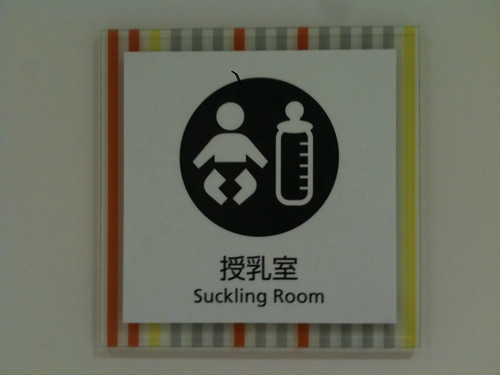
The internet is chockers with snapshots of poorly translated signs, some of which we have turned into dinky translation exercises over at the Routes into Languages page. This one was so good I couldn't resist:

suckling room @ musashikoyama

(The image is copyright and thanks to TR4NSLATOR, aka Jed Schmidt, over on Flickr.)

So apparently accurate, and yet so tragically wrong...

Thursday, 13 May 2010

translation funnies


Some light relief for exam stress/election frustration/combat fatigue/dissertation anxiety (delete as applicable):

The ALTA blog has a lovely page of foreign-language cover versions of songs and their originals. For generational-nostalgic reasons I particularly liked the German version of 'Walk Like An Egyptian', but there's something for everyone here.

And the New York Times has a great page of amusing translated signs from foreign places with more funny than you can shake a stick at (and some quite thought-provoking ones too).

Monday, 22 March 2010

attention to detail


Just reflecting on the importance of attention to detail for translators. Interpreting, of course, is about the expedient rapid solution rather than the painstaking search for the ideal. But a little more ideal would be good sometimes:


I hope this brings a smile to your Monday.

Tuesday, 10 February 2009

a cautionary tale...

...pleasingly presented as a short film, about relying on automatic translation software.

The film is called A Wicked Deception.

Just Say No...

Carol