Showing posts with label #filmtranslationhistory. Show all posts

Sunday, 1 December 2019

Films about industrial action (on the occasion of the UCU strike, 2019)

As the Universities and College Union strike goes into its second week, I find myself moved to blog about it. Followers of this blog will have noticed it's been a bit quiet recently.

(More accurately, it's been like this recently:)

via GIPHY


Unfortunately, blogging is one of the things I found much less time for as work has got more and more hectic. This is one of the issues that lies behind the strike (the link downloads a pdf with key issues around academic workloads).

But I have found blogging hugely rewarding over the years and I want to pick it up again, and so I'm taking the opportunity of the strike to talk about movies.

There's a grand tradition in Higher Education of the 'teach out' during industrial action, where students and staff come together to talk about ideas off campus as an alternative to cancelled classes and/or to crossing the picket line. I wanted to think about films that could allow us to talk through ideas about industrial action.

There are more moving and entertaining films about strikes out there than we might think! The ones I know reflect my own filmgoing and TV-watching generation:

Brassed Off (Herman 1996) is a musical about the miners' strike.


Bread and Roses (Loach, 2000) is based on the 'Justice for Janitors' campaign, waged by janitorial workers in Los Angeles who were trying to unionise.


The title Bread and Roses is based on the song of the same name, apparently originally inspired by a speech by the American union activist Rosa Schneiderman on the occasion of the 1912 Lawrence textile strike.

The 2004 BBC miniseries North & South is a romantic drama based on Mrs Gaskell's social realist novel about industrial unrest in the cotton mills of the north of England. Come for Richard Armitage's brooding but beautiful baritone, stay for the friendships across strict nineteenth-century British class boundaries:

 
Made in Dagenham (Cole, 2010) is the story of Rita O'Grady and the women machinists at Ford in Dagenham who went on strike for equal pay in 1968, which was followed by the passing of the Equal Pay Act in 1970.


Pride (Warchus, 2014) is about the miners' strike and the activism of a London-based group called Lesbians and Gays Support the Miners:


The film also includes a beautiful rendition of the song 'Bread and Roses':


Other films that have been suggested by friends and colleagues include I compagni, starring Marcello Mastroianni, a film about a textile workers' strike in Turin in the late nineteenth century:


(From a #filmtranslationhistory perspective I cannot help noticing that nothing is said in this vintage American trailer about the industrial action itself, though there's plenty of the Mastroianni-as-star and women-in-their-undergarments typical of contemporary US perceptions of Italian cinema).

John Sayles's Matewan is set during a coal miners' strike in 1920 in West Virginia (see here for Sayles talking about some of the film influences on Matewan, which include The Organizer):


Kevin Brownlow's 1975 film Winstanley, a historical drama about Gerrard Winstanley and the Diggers, is available to watch on the BFI player.

For fans of Russian cinema and silent film I must mention Eistenstein's silent 1925 Strike and Pudovkin's 1933 silent Deserter, both watchable in various versions on Youtube.

On Tuesday last we saw Comrades, directed by Bill Douglas, released in 1986, an extraordinarily beautiful and moving film about the Tolpuddle Martyrs. Run, do not walk, to see this film (though be aware that it is 183 minutes long). It has recently been re-released and looks brilliant on a big screen.


On Monday afternoon I will be showing Pabst's Kameradschaft [Comradeship] (1931) at Twentieth Century Flicks video shop on the Christmas Steps. This is a film not about industrial action but about international solidarity between workers, which was not available for many decades but has now been re-released. The film was shot in French and German as a way of respecting both communities equally. Bristol folks who would like to come, please DM me on Twitter.

Again, run rather than walk to see this film. It's a lost treasure, and one of the first films to be released in the UK with English subtitles (by Paul Rotha). The re-release has new subtitles.

I hope these suggestions for filmwatching will help to inspire and energise my fellow strikers and our students, many of whom have been providing stalwart support in the form of hot drinks, cake and solidarity. Suggestions for more good films about industrial action are warmly welcome in the comments.

Monday, 16 April 2018

Two upcoming events: research seminar and film screening

I am very happy to announce two imminent events:


The first is a research seminar tomorrow, which looks fascinating and is free and open to all:


When Translation Multiples Tell Their Own Story

Dr Kasia Szymanska, Oxford University
Tuesday 17 April
16:00 - 17:30 | LR2, 43 Woodland Rd, University of Bristol

Kasia Szymanska is a Junior Research Fellow in Modern Languages at Oxford University, where she is a member of the committee of the Comparative Criticism and Translation Research Centre.  Her research lies in literary translation thought, experimental translations, and multilingual poetics - especially with reference to the East European context.  She was awarded the 2015 EST Translation Prize and is currently serving as one of the judges of the 2018 Oxford-Weidenfeld Translation Prize.

*****

The second event is an ultra-rare 35mm film screening on Sunday 22 April


Treasures from the Turin Film Museum


The silent period was a golden era for Italian cinema, with pioneer directors like Giovanni Pastrone, whose 1914 epic Cabiria influenced filmmakers such as D.W. Griffith. Historical epics were particularly popular. This event features five restored films from the collections of the Turin Film Museum, all with a classical theme. They include Pastrone’s Fall of Troy (1911) and The Last Days of Pompeii (1910), from the novel by Edward Bulwer-Lytton, which was the first Italian historical epic. The programme also includes Hero and Leander and Dido Abandoned from 1910; and Judas from 1911.

Followed by a Q&A featuring Stella Dagna from the Turin Film Museum, Professor Maria Wyke from UCL, Dr Pantelis Michelakis from the University of Bristol, and our distinguished accompanist Mr Stephen Horne.

The event is generously supported by a grant from the Institute for Greece, Rome and the Classical Tradition at the University of Bristol. Organised in partnership with South West Silents.

Tickets are available here at the Watershed website (booking recommended): https://www.watershed.co.uk/whatson/8824/treasures-from-the-turin-film-museum


Tuesday, 3 January 2017

An Odd Adventure: New Year's musings on subtitles from 1932

Regular readers of this blog or of my Twitter feed will know that I'm working on the history of subtitling. As a happy new year greeting to all three of my faithful readers, here's a short piece from Edwin Schallert of the Los Angeles Times, published on 2 January 1932, a few months after subtitles had begun to appear in the United States (previously audiences had either had to speak the language in question, or make do with a synopsis in the programme).

They were called 'superimposed titles' to differentiate them from intertitles, which were interpolated between moving picture footage, rather than superimposed. Intertitles were referred to at the time as subtitles, to add to the confusion. Reading the rather plodding explanation below, we should remember that these were viewers used to silent films, where the action had to stop when a title card appeared. The idea of a title running concurrently with the action was a bit revolutionary:

Superimposed Titles
Witnessing a picture with superimposed titles, so-called, is an odd adventure. Superimposed titles are explanatory subtitles printed on scenes in the film, which translate the purport of what is being said in another language. They are being used in Europe on the American pictures. The words spoken in English are those translated into German, French or some other language, depending on what country the picture is shown in, so that its dialogue may be understood by the audience.
   I saw the French film, 'David Golder,' with superimposed German titles, and a knowledge of that language made it exceedingly easy to folow. The words spoken in French, which is often a difficult language to understand conversationally, acquired meaning as the picture progressed. It would seem, therefore, that the viewing of pictures with superimposed titles is an aid in acquiring a knowledge of a different tongue. Nor is it as complicated nor as distracting a method of witnessing a picture show as might be imagined.                      (2 January 1932, p.19)

Harry Baur, as David Golder (Duvivier, 1931) with his horrible daughter Joyce, played by Jackie Monnier


As a bonus extra feature on this blog post, here's a snippet by Harrison Carroli a few months later in the Evening News of Wilkes-Barre, Pennsylvania:

A superimposed title, in case the term leaves you with a blank feeling, is the old-fashioned silent title cut down to a narrow strip and imposed across the bottom of the image on the screen. In Japan it's a perpendicular strip along the side. This title translates or explains the English dialogue, which goes on without interruption.(22 April 1932, p.9)

Tuesday, 19 July 2016

Early film translations: Marcel Carné on the first subtitled films in France

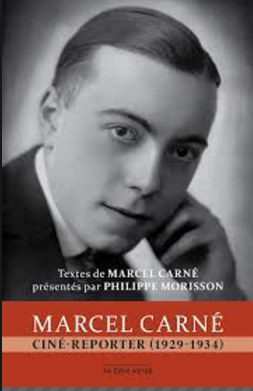
An excellent volume of Marcel Carné's film criticism has just appeared: Marcel Carné: Ciné-reporter (1929-1934), edited by Philippe Morisson and published by La Tour Verte.

One section, entitled 'Cet art qui fut muet et devint parlant: Articles sur les talkies' [That art that was dumb and became talking: Articles on the talkies], includes pieces published in Cinémagazine and other film magazines between August 1929 and April 1931, at the height of the transition from silent to sound films. Carné covers what it is like on a film set shooting a sound picture, discusses the technical requirements and skillsets required to shoot and edit sound film (at a time when the camera was just emerging again from its soundproof booth), and debates with Marcel Lapierre about whether silent film has, in fact, had its day.

One of the pieces, 'De l'internationalité du film parlant' ['On the internationalism of the talking picture'] published in Cinémagazine 48, 29 November 1929, gives a fascinating viewpoint on the development, and unpopularity, of subtitles in France. This is so relevant to my own research on film translation between the silent and the sound periods (see http://www.britac.ac.uk/events/2015/Splendid_Innovations.cfm) that I hope I will be forgiven for quoting it at some length. It is also cited by my colleague Dr Jean-François Cornu in his 2014 book Le doublage et le sous-titrage. Histoire et esthétique (Presses Universitaires de Rennes),

I have taken the liberty of putting a few particularly interesting phrases in bold, including the speculation that talking films might, like great books, one day have translators of their own (gosh!); and the condemnation that subtitling was a cognitive impossibility for audiences. The first of these statements is not false as such; but the low status of film translators relative to literary translators (see this post for more on this) makes it in some ways a slightly skewed prediction.

 The translation that follows, and any errors in it, are my own.
Le seul reproche - il est vrai qu'il est de taille - qu'on puisse adresser aujourd'hui au film parlant, est que du jour où le cinéma a trouvé la parole, il a cessé d'être un art international par excellence.
   Encore faudrait-il s'entendre là-dessus; le cinéma parlant est national au même titre que la littérature ou le théâtre. Et nous verrons tout à l'heure qu'il est fort possible que, d'ici quelque temps, le film parlé, produit d'une race, ait, lui aussi, ses traducteurs, tout comme un chef-d'oeuvre de la littérature ou une pièce consacrée dans son propre pays, par un succès éclatant.
   À l'origine des talkies, on imagina, pour tourner la difficulté, de sur-impressioner sur l'image des sous-titres explicatifs. Au début, la curiosité l'emporta: il nous suffit de citer le succès du Chanteur de jazz et de La Chanson de Paris. Pourtant, ce que les spectateurs toléraient pour les premiers films, ils l'admirent moins facilement par la suite.
C'est ainsi que Weary River, pour n'en citer qu'un, valant très largement les deux premiers, connut un succès honorable, certes, mais ne souffrant pas la comparaison avec ses deux devanciers. Encore plus que l'absence d'une très grande vedette (car Barthelmess, malgré son grand talent, n'a pas la célébrité d'un Chevalier), les nombreux sous-titres français intercalés dans Weary River ne furent pas étrangers à cet état de choses. Il n'est, au reste, pas une personne à l'heure actuelle qui n'ait compris que ce système n'est qu'un pis-aller qui ne saurait subsister bien longtemps encore. Outre que cela est fort désagréable, il est matériellement impossible à un spectateur de suivre à la fois le jeu parlé des acteurs et de lire les sous-titres inscrits dans le bas de l'image.
   Et puis n'est-il pas paradoxal que le film parlant, au lieu de supprimer les sous-titres comme on était en droit de attendre de lui, les multiplie, au contraire, à l'infini?
   Un établissement des boulevards n'annonce-t-il pas actuellement un film parlant américain cent pour cent parlant avec de nombreux sous-titres français; alors qu'une telle annonce eût fait fuir les spectateurs il y a seulement un an! Enfin, les lecteurs de cette revue n'ont pas été sans remarquer que le procédé de surimpression des titres nécessite, ce que l'on appelle en termes techniques, un contretype, c'est-à-dire un double tirage du négatif, ce qui a pour efet d'obscurcir singulièrement la photographie la plus lumineuse.
   Donc, à tous les points de vue, le système s'avérait détestable. Aussi, a-t-on cherché autre chose. Et la lumière nous est venue, cette fois, de l'Angleterre. [...]
My translation: The only reproach - though, to be fair, a substantial one - that could be directed today to the talking film, is that from the moment that cinema discovered words, it ceased to become the international art par excellence.
   Let us be clear: the sound cinema is national in the same way as literature or theatre are. And we will see shortly that it is entirely possible that, some time in the future, the talking film, as a national product, will itself also have its translators, just as a literary masterpiece might, or a theatre play which has been a major success in its own country.
   When talkies began, someone came up with the idea of solving the problem by superimposing explanatory sub-titles on the image. This passed muster with early spectators, as witness the success of The Jazz Singer and Innocents of Paris. But what spectators tolerated in the first sound films was less welcome to them as time went on. That explains why Weary River, for instance, every bit as good as the two earlier films, met with fair success, sure, but nothing like its two predecessors. This will have been partly due to the lack of a major star (because Barthelmess, while a very talented actor, has nothing like Maurice Chevalier's fame), but the many French subtitles in Weary River were also a factor. There isn't anybody, at this point, who hasn't realised that this system [subtitling] is nothing but a shabby compromise whose days are numbered. Apart from the fact that it is very disagreeable, it is materially impossible for a spectator to follow the actors' performances and to read the subtitles at the bottom of the image at the same time.
   And is it not paradoxical that the talking film, instead of suppressing titles as we might have expected, is instead proliferating them into infinity?
   Is a popular Paris cinema not currently advertising a 100 per cent talking American film with many French subtitles, though such an advertisement would have made spectators take to their heels only a year ago! And readers of this periodical have taken the opportunity to observe that the superimposition of titles on the image requires what is technically referred to as a contretype, in other words a duplication of the negative, the result of which is a noticeable darkening of even the brightest photographic image.
   So, on all fronts, the system has proven detestable. Another solution was sought. And the light came, this time, from England. [...]

(c) for the translation Carol O'Sullivan, 2016. Many thanks to Sam B. for picking up a couple of errors in the draft.

Wednesday, 11 November 2015

The return of the translating dissolve

In my book Translating Popular Film I talked about the device of the 'translating dissolve' which was so common in the 1920s and 1930s. Here's an example from the wonderful Frank Capra film The Bitter Tea of General Yen (1933), with the wonderful Nils Asther in far-from-wonderful yellowface as the eponymous general:


The translating dissolve is also described by David Cairns on his excellent 'Shadowplay' blog, and at more length by R. John Williams in a very interesting and lavishly illustrated article from 2009, 'Global English Ideography and the Dissolve Translation in Hollywood Film'. Cairns uses the example of Daughter of the Dragon (Corrigan, 1931). In my book I argued that the 'translating dissolve' represented a kind of perceptual 'point of view' shot where the viewer gets to see from the point of view of a character who understands the source language:


Odd it may have been, but it was a standard way of making foreign-language written texts 'processable' for American viewers and thus contributed in an important way to linguistic realism in film.

I came across another interesting example this evening leafing through Daisuke Miyao's book Sessue Hayakawa: Silent Cinema and Transnational Stardom, where a translating dissolve from the film The Typhoon (Barker, 1914) proves to be more than it seems (the relevant bit starts at the bottom of page 70):


This underlines how long-lived this particular device was; from the 1910s to the 1930s and beyond. It also made me wonder how early this device was used. I'd be delighted to hear from any readers with earlier examples, or with examples later than the 1930s.

Sunday, 25 October 2015

Silent film viewing in Luxembourg, c.1920

I really enjoyed this post on Luke McKernan's excellent Picturegoing blog, which quotes an account by the American journalist Robert Joseph Casey (1890-1962) of going to the cinema in the town of Ettleburck in Luxembourg shortly after the First World War:
I suspected from the first that “On the Line of the Four,” however much it might promise as a war picture, was very likely our old friend and neighbor “The Sign of the Four,” and so it was.

The original nationality of the piece was a doubtful matter. There was hardly enough of it left to give one a consecutive idea of the plot, and the French captions were so worn that little was to be gained from them. It may have been an American film of that era when there were no stars. At any rate, no latter-day favorites appeared in it. It may have been English. Certain elements in the “locations” suggested England forcibly. But whatever its pedigree, its days of usefulness were nearly done.

The Anglo Saxons in the house, to whom the name Sherlock Holmes was a sufficient guaranty of story action and plot, could not get very far with the titles in French. Those who had mastered enough of the language to surmount this difficulty were certain to become hopelessly muddled in the aimless mixing of scenes that seemed to be the result of many years of “cut and patch.”
This issue of the difficulty of identifying a silent film's origin echoes the story of the 'O'Kalem collection', a DVD release of the surviving films shot by the Kalem film company (in its various incarnations) in Ireland between 1910 and 1915. The fact that two of the films, The Lad from Old Ireland (1910) and His Mother (1912), only survived in German and Dutch versions respectively, 'delayed their identification by scholars over the years', as we are told in the very informative booklet accompanying the DVD.

Thursday, 15 October 2015

Translating silent film: 'Kid Speed' (1924)

OK, silent film translation time. I just came across two different language versions of Kid Speed (Semon, 1924), a comedy short featuring one Oliver N. Hardy. One version is in English; the other is in Italian, from an off-air recording from RAI television.

The English version can be found here:


The Italian version, entitled Ridolini e il suo bolide, is here


The original YT poster dates this broadcast to the 1970s:
La pellicola è una versione della Rai, probabilmente databile negli anni '70: ad un certo punto si può ascoltare una versione del brano "Il re del piffero", sigla della serie "Le simpatiche canaglie", ovvero i corti delle "Our Gangs" trasmessi dalla Rai nella seconda metà degli anni '70. Altra chicca è il cappello introduttivo del cortometraggio che viene presentato come comica americana presentata da Jean Gaborit e Jaques Durant [sic], due amanti del cinema famosi per le ricostruzioni e le riscoperte di pellicole storiche; loro è infatti la ricostruzione della versione originale del 1939 de "La regola del gioco" di Jean Renoir.
[The film is a RAI version, probably dating from the 70s; at a certain point you can hear a version of the song 'Il re del piffero', the theme song of the series 'Le simpatiche canaglie', which were the Our Gang shorts broadcast by RAI in the second half of the 1970s. Another nugget is the intro to the short which is presented as American funnies presented by Jean Gaborit and Jaques Durant [sic], two film lovers famous for reconstructing and rediscovering old films: it was they who reconstructed the original version of Jean Renoir's Rules of the Game from 1939.]


The English version runs slightly over eighteen minutes; the Italian clip less than fourteen, but it's typical of these broadcast versions to be quite cut about. What's interesting is to look at which bits have been maintained and which have been lost. The English-language version has a lot of verbal as well as visual humour. The scene is set in rhyme:


There are some quite marked shifts in register between the titles:


(I can't work out why the two different typefaces and layouts.)
Some of the titles introduce the characters and the actors who play them:


(The writer seems temporarily to have run out of rhymes here.)


(I am embarrassed to say that the penny took a few minutes to drop with 'Phil O'Delfya'.)
 

(btw any readers know what the 'million gate' is?)

The Italian credits don't introduce the characters like this, and the full cast list in the opening credits is missing too. Instead they give us an opening credit for Semon, and one for Hardy and a 'Patty Alexander':


This is a bit mystifying, since the only actress in the film is Dorothy Dwan, and on checking, she doesn't seem to have masqueraded at any point as Patty Alexander, though she did start out in life as Dorothy Illgenfritz. There is a Frank Alexander, but...? Mystery unresolved. (For more on mysteriously differing character names in Italian film versions, see old post 'Who is Fred?').

The Italian clip blithely ignores all the scene-setting and verbal dexterity of the original. It has many fewer titles - is, in fact, positively laconic:


[Ridolini, with his help, is fine-tuning the meteor/vehicle he will drive in the Grand Prix.] (I'm not sure who 'suo' refers to here.)


[The philanthropist who organised the race pays a visit with his daughter to the main contestants.]


[The day of the race.] Note that this title corresponds to the following title in English:


The Speed Kid (Semon) and Dan McGraw (Hardy) are rivals for the affections of Avery DuPoys' daughter Lou, played by Dorothy Dwan. Her father promises that whoever wins the race can date her:


Dan McGraw gets very excited about this, and tries to get his goons to sabotage his rival:


But in Italian, he only seems to be interested in the race:


[Get rid of that Ridolini! The Grand Prix will be mine!]

The clips raise lots of questions. Are these two versions in themselves complete, or have they lost other bits along the way? Are these Italian titles the earliest available titles, or were there at any point earlier, perhaps more fully translated titles? Can we in any sensible way consider these two films as original and translation?

It's clear that even if silent film *can* lay claim to being easy to translate because the titles in the target language can just be refilmed and substituted, it doesn't mean that silent film *is* translated in so straightforward a manner. The whole texture of the film has changed. Taking out the wordy English titles changes the nature of the comedy, rebalancing the film in favour of the slapstick. Paratextually, it's reframed as a nostalgic pleasure, rather than for a contemporary audience. And the Italian titles are poorer not just semantically, but aesthetically; the two typefaces used in the original (for reasons which aren't clear to me, since they don't seem to correspond to any distinction between, say, narrative and dialogue titles) are reduced to one very functional one. And that's of course without even considering all the other ways in which the film could have been recut, which is beyond the scope of this little post.

The whole question of what actually constitutes 'part of the film' for the purposes of translation is at issue. But more on the (para)textual status of intertitles in a future post.

Saturday, 12 September 2015

Translating silent film: British Silent Film Festival, Leicester, September 2015


I've been blown away by the experience of attending the British Silent Film Festival. It's the first time I've been at the Festival, though it has a long and distinguished history (it's in its eighteenth year). This year's Festival is at the wonderful Phoenix cinema and cultural centre in Leicester (a most sensible place, where you can even buy a flat in the same building for easier cinemagoing). It was lovely to meet up again with some well-known faces from the Splendid Innovations conference too.

Other people more knowledgeable than I am are blogging the Festival (see e.g. Silent London) and so I will concentrate on things translationy (though I would love to rave about the wonderful sailing footage on Windjammer, or the brilliant slapstick of Buston Keaton in Steamboat Bill, or, or....).

A number of films were screened at the Festival in their original languages with a spoken translation. This worked really well and it was interesting how the different film explainers gave the films quite a different tone. Neil Brand did great accents for the Dutch titles on the only available print of The Man from Home (Fitzmaurice, 1922), which helped give an extra touch of entertainment to an otherwise ho-hum film. Bryony Dixon's narration added ironical notes to the very good Swedish film Den Starkaste [The Strongest] (Sjöberg & Lindblom, 1929), a story of romantic rivalry between two ship's marksmen hunting for seal and bear in the Arctic.

A gentleman whose name I unfortunately didn't find out heroically improvised a spoken narration to Tourjansky's Michel Strogoff (1926) - a task made extremely difficult both by the film's titles and inserts (often very wordy, rather cramped, lots of handwriting, varying formatting, and not long enough on screen) and by the sheer length of the film (nearly three hours). It gave a whole new tone to the film and made me very aware of every title and text insert - and nearly distracted from the amazingly beaux yeux of Ivan Mosjoukine:


Image borrowed from this excellent review of Michel Strogoff at Moviessilently, hoping the owner will not mind.

For more on the skill and resourcefulness needed for festival film interpreting, see this article on film festival interpreting in the USSR by Elena Razlogova (subscription only). Props also to John Sweeney for his thrilling accompaniment to the film (though in fairness, all the musicians I heard were marvellous).

Two films were screened for which Alfred Hitchcock designed the titles, way back in the day when he worked for Famous Players-Lasky British. One was The Man from Home; only one print survives, with Dutch titles, mentioned above. The other was Three Live Ghosts (also Fitzmaurice, 1922) which was thought lost, as Charles Barr fascinatingly recounted, until a truncated print was found in Russia. The image on the front of the Festival brochure above is from this film. This was for me the real treasure of the Festival because of the way it had been cut, recut, added to and adapted.

Translation Studies scholars have tended to follow pioneer scholars such as Jan Ivarsson on the relative simplicity of translating silent film: 'the original titles were removed, translated, filmed, and re-inserted'. I imagine that in most cases, this was quite true. But someone working from a more Descriptive-Translation-Studies point of view might ask: OK, it was potentially easy to translate intertitles, but were silent films, in practice, so straightforwardly translated? There's plenty of evidence to suggest that intertitles were subject to the same kinds of 'deforming tendencies' (Berman's phrase) as any other translation. There's also plenty of evidence that silent films were routinely recut as well as retitled (see my previous post on Adrian Brunel's work editing silent films for import to the UK, or those juxtaposed versions of the same Chaplin film in English and Russian that I would look up on Youtube if I wasn't currently on a train...). Intertitles also pose other problems with layout, typeface, production values, etc., and technical/material problems which affect their preservation - see Enno Patalas, for instance, on Nosferatu (paywalled).

I would argue that we shouldn't see this editing work as external to the translation of the film; editing, retitling, adjusting for the target market are surely all part of the same process. Admittedly, Three Live Ghosts seems like a spectacular case, including, as Charles Barr described to us yesterday, the changing of characters' names, backstories and motivations, as well as the likely addition of footage not belonging to the original film. I look forward some day to reading a full account of this particularly intriguing silent film translation.