Showing posts with label French. Show all posts

Thursday, 26 January 2017

Upcoming lecture by Dr Henry Liu, University of Bristol, 8 February 2017

We're delighted to announce a very distinguished speaker at the University of Bristol: Dr Henry Liu, current President of the International Federation of Translators (FIT).


Asset Bubbles, Derivatives, Crisis and Translation
Dr Henry Liu
President, International Federation of Translators

School of Modern Languages
University of Bristol
3-5 Woodland Road, BS8 1TE

Wednesday 8 February
5.15-6.30pm
Venue: Link Room 2

Wine reception to follow. All welcome.

Asset Bubbles, Derivatives, Crisis and Translation
Many people, including our colleagues, have predicted the end of translation and interpreting as professions with the advancement of automated translation and now with ever more sophisticated algorithms and artificial intelligence. Despite this ever-deepening crisis, especially with tumbling remunerations to individual practitioners, there is rapid proliferation of translation and interpreting training and programmes around the world and LSPs are sold at astonishing record sums.
In this lecture, the President of FIT will draw on the experience and learning from the 2007 global financial crisis and apply them towards rebalancing the power dynamics within and without this critically important profession as well as developing strategy in the face of such disruption.


Dr Henry Liu is a consultant interpreter in English, Chinese and French. He has been an interpreter for heads of state and other dignitaries. He has been involved in many international conferences, including APEC, and has accompanied many missions abroad. His specialties are law, diplomacy and international trade.
A long-time member of the New Zealand Society of Translators and Interpreters (NZSTI), he is heavily involved in professional training and setting up of professional standards and guidelines. He has been instrumental in bringing together practitioners of Maori, English, and New Zealand Sign Language. He has also been an advisor to many government departments in relation to interpreting and translation policies, access and quality issues. An opinionated advocate of professional organisations and a strong believer in trans-national and multidisciplinary co-operation, Henry has given keynote addresses in major T&I conferences in Oceania, North America, Europe, Asia and Latin America.

Henry is a fantastic speaker, so we hope many of you will be able to join us for what promises to be a fascinating and provocative talk.


P.S. And don't forget our Translation Slam with Alice Jones and Stephen Green, in partnership with the Western Regional Group of the ITI, taking place on Tuesday 31 January!

Follow us on @BristolMATrans for more information on upcoming events and useful translation stuff.

Sunday, 2 October 2016

Mystery dubbed film: WW2 film 'Behind these Walls'?


Hello gentle readers, I've been burrowing in Irish newspaper archives recently, for my own nefarious research purposes, and am a bit perplexed by something (well, more than one thing, but you know what I mean).

On 23 May 1948, Noel F. Moran, film critic of Ireland's Sunday Independent, reviewed an Anglo-French coproduction by the title Behind These Walls in his regular column 'This week's Films' (p.2). I'm unable to find any record of a film with this title, and as you will see below, he doesn't give any helpful information about actors, director etc., because he is too busy complaining about the dubbing.

I'm casting this one out to the 'verse, and would be very grateful if any readers or their acquaintances could shed any light on what the film might be. Here's what NFM says about the film:
The Anglo-French film "Behind These Walls" (Regal) is more notable as a technical experiment than as a story of the French Resistance Movement. It is, to my mind, an experiment that fails but, let me hasten to add, not on the technical side.
     The background is French: the characters are French. By means of the De Lane Lea process of English speech recording (it is known as "Lingua Synchrone"), these characters are given English voices to speak the English dialogue. Technically, as I have already implied, the process is a success. The synchronisation is a definite advance on the old hit-and-miss methods of dubbing, utilised largely on the Continent and in America. But, what has happened to the atmosphere and the realism? They have gone with the wind.
     At its best, the picture could never be regarded as another "Open City". It has not the same scope or stature, nor does it seek to give the same comprehensive survey of a great nation under the heel of the invader. Made with R.A.F. co-operation, it is a recreation of a true incident. A group of ordinary people face a tragically simple problem - whether or not to blow up a German benzine [sic] train and sacrifice the lives of 50 of their fellow countrymen, held as hostages. Emphasis is on the reactions of these hostages as they await their fate - the Mayor, outwardly calm but sick inside; the doctor; the old beggar, facing destiny philosophically; the spiv; the coward; all the unspectacular heroes and heroines of the back streets.
     The characterisation has all the visual appeal and the sensitivity one has come to associate with the French cinema - all set at nought by those English voices, which make the film neither fish, flesh nor good red herring, to to speak. The cockney-like voice of the tramp, for instance, is described in the publicity sheet as "a forthright accent that drives home the essential provincialism of the French original hero of this dramatic part". My imagination is not sufficiently vivid to catch the analogy. Give me the original French version, with English sub-titles, however inadequate. When I go to see a French film, I want to see a French film. Running time: 1 hour, 32 minutes.

UPDATE later that evening: Warm thanks to Lucy M. and Sam B. who have solved the mystery. The film is Jericho, also known as Behind These Walls, directed by Henri Calef and released in 1946. There does appear to be some confusion about the title. The film was reviewed in the New York Times on 6 December under the title Jericho ("exultant drama in the truly fine, French tradition"). There is no mention of the translation but it seems more likely that it was the subtitled version since it played at the 55th St. Playhouse which showed a lot of subtitled imports. Jericho was also the French release title. It was reviewed twice in the Monthly Film Bulletin in the UK, on 1 January 1947 for the dubbed version under the title Behind These Walls, on 1 January 1948 for the English-subtitled version, under the title Derrière ces murs. The subtitles were referred to as 'adequate' and the dubbed version 'not too offensive'.

Tuesday, 19 July 2016

Early film translations: Marcel Carné on the first subtitled films in France

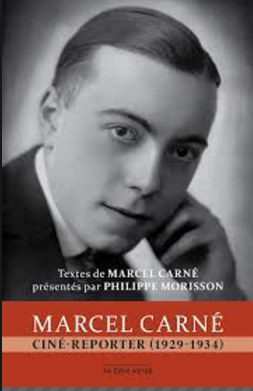
An excellent volume of Marcel Carné's film criticism has just appeared: Marcel Carné: Ciné-reporter (1929-1934), edited by Philippe Morisson and published by La Tour Verte.

One section, entitled 'Cet art qui fut muet et devint parlant: Articles sur les talkies' [That art that was dumb and became talking: Articles on the talkies], includes pieces published in Cinémagazine and other film magazines between August 1929 and April 1931, at the height of the transition from silent to sound films. Carné covers what it is like on a film set shooting a sound picture, discusses the technical requirements and skillsets required to shoot and edit sound film (at a time when the camera was just emerging again from its soundproof booth), and debates with Marcel Lapierre about whether silent film has, in fact, had its day.

One of the pieces, 'De l'internationalité du film parlant' ['On the internationalism of the talking picture'] published in Cinémagazine 48, 29 November 1929, gives a fascinating viewpoint on the development, and unpopularity, of subtitles in France. This is so relevant to my own research on film translation between the silent and the sound periods (see http://www.britac.ac.uk/events/2015/Splendid_Innovations.cfm) that I hope I will be forgiven for quoting it at some length. It is also cited by my colleague Dr Jean-François Cornu in his 2014 book Le doublage et le sous-titrage. Histoire et esthétique (Presses Universitaires de Rennes),

I have taken the liberty of putting a few particularly interesting phrases in bold, including the speculation that talking films might, like great books, one day have translators of their own (gosh!); and the condemnation that subtitling was a cognitive impossibility for audiences. The first of these statements is not false as such; but the low status of film translators relative to literary translators (see this post for more on this) makes it in some ways a slightly skewed prediction.

 The translation that follows, and any errors in it, are my own.
Le seul reproche - il est vrai qu'il est de taille - qu'on puisse adresser aujourd'hui au film parlant, est que du jour où le cinéma a trouvé la parole, il a cessé d'être un art international par excellence.
   Encore faudrait-il s'entendre là-dessus; le cinéma parlant est national au même titre que la littérature ou le théâtre. Et nous verrons tout à l'heure qu'il est fort possible que, d'ici quelque temps, le film parlé, produit d'une race, ait, lui aussi, ses traducteurs, tout comme un chef-d'oeuvre de la littérature ou une pièce consacrée dans son propre pays, par un succès éclatant.
   À l'origine des talkies, on imagina, pour tourner la difficulté, de sur-impressioner sur l'image des sous-titres explicatifs. Au début, la curiosité l'emporta: il nous suffit de citer le succès du Chanteur de jazz et de La Chanson de Paris. Pourtant, ce que les spectateurs toléraient pour les premiers films, ils l'admirent moins facilement par la suite.
C'est ainsi que Weary River, pour n'en citer qu'un, valant très largement les deux premiers, connut un succès honorable, certes, mais ne souffrant pas la comparaison avec ses deux devanciers. Encore plus que l'absence d'une très grande vedette (car Barthelmess, malgré son grand talent, n'a pas la célébrité d'un Chevalier), les nombreux sous-titres français intercalés dans Weary River ne furent pas étrangers à cet état de choses. Il n'est, au reste, pas une personne à l'heure actuelle qui n'ait compris que ce système n'est qu'un pis-aller qui ne saurait subsister bien longtemps encore. Outre que cela est fort désagréable, il est matériellement impossible à un spectateur de suivre à la fois le jeu parlé des acteurs et de lire les sous-titres inscrits dans le bas de l'image.
   Et puis n'est-il pas paradoxal que le film parlant, au lieu de supprimer les sous-titres comme on était en droit de attendre de lui, les multiplie, au contraire, à l'infini?
   Un établissement des boulevards n'annonce-t-il pas actuellement un film parlant américain cent pour cent parlant avec de nombreux sous-titres français; alors qu'une telle annonce eût fait fuir les spectateurs il y a seulement un an! Enfin, les lecteurs de cette revue n'ont pas été sans remarquer que le procédé de surimpression des titres nécessite, ce que l'on appelle en termes techniques, un contretype, c'est-à-dire un double tirage du négatif, ce qui a pour efet d'obscurcir singulièrement la photographie la plus lumineuse.
   Donc, à tous les points de vue, le système s'avérait détestable. Aussi, a-t-on cherché autre chose. Et la lumière nous est venue, cette fois, de l'Angleterre. [...]
My translation: The only reproach - though, to be fair, a substantial one - that could be directed today to the talking film, is that from the moment that cinema discovered words, it ceased to become the international art par excellence.
   Let us be clear: the sound cinema is national in the same way as literature or theatre are. And we will see shortly that it is entirely possible that, some time in the future, the talking film, as a national product, will itself also have its translators, just as a literary masterpiece might, or a theatre play which has been a major success in its own country.
   When talkies began, someone came up with the idea of solving the problem by superimposing explanatory sub-titles on the image. This passed muster with early spectators, as witness the success of The Jazz Singer and Innocents of Paris. But what spectators tolerated in the first sound films was less welcome to them as time went on. That explains why Weary River, for instance, every bit as good as the two earlier films, met with fair success, sure, but nothing like its two predecessors. This will have been partly due to the lack of a major star (because Barthelmess, while a very talented actor, has nothing like Maurice Chevalier's fame), but the many French subtitles in Weary River were also a factor. There isn't anybody, at this point, who hasn't realised that this system [subtitling] is nothing but a shabby compromise whose days are numbered. Apart from the fact that it is very disagreeable, it is materially impossible for a spectator to follow the actors' performances and to read the subtitles at the bottom of the image at the same time.
   And is it not paradoxical that the talking film, instead of suppressing titles as we might have expected, is instead proliferating them into infinity?
   Is a popular Paris cinema not currently advertising a 100 per cent talking American film with many French subtitles, though such an advertisement would have made spectators take to their heels only a year ago! And readers of this periodical have taken the opportunity to observe that the superimposition of titles on the image requires what is technically referred to as a contretype, in other words a duplication of the negative, the result of which is a noticeable darkening of even the brightest photographic image.
   So, on all fronts, the system has proven detestable. Another solution was sought. And the light came, this time, from England. [...]

(c) for the translation Carol O'Sullivan, 2016. Many thanks to Sam B. for picking up a couple of errors in the draft.

Wednesday, 17 February 2016

Upcoming translation lectures, Bristol

We've got several very interesting speakers on translation coming up at Bristol, details below. All welcome, no charge.


**Please note that for anyone who doesn't have the door code, the entrance to the Arts Complex is via 3-5 Woodland Road.**


'Prismatic Translation'

Professor Matthew Reynolds
St. Anne's College, Oxford

Tuesday 1 March 2016, 5.15pm
LR1 (Lecture Room 1)
Arts Complex, 3-5 Woodland Road


What happens when you see translation as prismatic – i.e. when you stop looking for the best version in the given circumstances, and instead revel in translation’s power to produce multiple variants? This talk will look at various manifestations of prismatic translation: through history, across languages, in dialogue, and as a creative practice (most of the examples will be literary and in English, or rather Englishes). It will ask how far our thinking about translations, and our ways of reading them, might need to shift if we adopt a prismatic view.

Matthew Reynolds teaches at Oxford where he chairs the interdisciplinary research programme Oxford Comparative Criticism and Translation (OCCT). Recent publications include The Poetry of Translation: From Chaucer & Petrarch to Homer & Logue (2011), Likenesses: Translation, Illustration, Interpretation (2013) and the novel The World Was All Before Them (2013). He has just finished writing Translation: A Very Short Introduction for OUP.

For further information, please contact Rebecca Gould (r.gould at bristol.ac.uk)


'French Atlantic Cities in Translation'

Professor Bill Marshall
University of Stirling

Tuesday 8 March 2016, 5.15pm,
LT3 (Lecture Theatre 3)
Arts Complex, 17 Woodland Rd (entrance via 3-5 Woodland Road if you don't have the door code)

This lecture takes off from Professor Marshall’s earlier work on the French Atlantic and combines this with insights by Montreal scholar Sherry Simon on 'cities in translation'. Taking the cases of nineteenth-century New Orleans and Montevideo, it will track the specific workings of translation that shed light on both the particularity of those sites and also on those aspects of transoceanic exchange and transformation which, in these urban contexts, invent new forms and question old orthodoxies. The lecture will include discussion of Sidonie de la Houssaye, Victor Séjour, Lautréamont, Julia Kristeva and Jacques Rancière.

All welcome.

For further information, please contact Martin Hurcombe (M.J.Hurcombe at bristol.ac.uk)

**Watch this space**:  more lectures coming up, inc.

**Now updated with latest event!**

'Presenting Mr Magarshack: The Story of a Russian Agent and his Classic Collection of Penguins'
 
Cathy McAteer

Thursday 17 March 2016, LR8, 21 Woodland Road, BS8 1TE (entrance via 3-5 Woodland Road except if you have the door code)

This paper will focus on Penguin's re-launch in the 1950s of classic Russian literature in English translation, with special attention given to David Magarshack, best known as Penguin's first translator of Dostoevskii, but also (unbeknownstto many) a journalist, novelist, translator, and translation theorist.

Enquiries to Ruth.Coates [at] bristol.ac.uk

Monday, 4 January 2016

'Translating Wordplay' conference, Lille, 23-24 March 2017

This looks like a really nice conference:

Call for papers:  International conference

Du jeu dans la langue. Traduire les jeux de mots / 
Loose in Translation: Translating Wordplay

23-24 March 2017
Université de Lille, France

https://www.univ-lille3.fr/recherche/actualites/agenda-de-la-recherche/?type=1&id=1271

The English version of the call is below. 

Selon la distinction établie par Bergson, le jeu de mots, en tant que comique créé par le langage, est réputé intraduisible, contrairement à celui qui est exprimé par le langage – une impossibilité qui résiste mal au fait que les traducteurs triomphent des jeux de mots au quotidien, car, composante universelle, l’humour peut toujours être traduit à l’aide d’équivalents. On pense immédiatement aux jeux sur et avec les mots (anagrammes, antanaclases, calembours, contrepèteries, paronomases…) ainsi qu’aux jeux sur le langage (création linguistique à visée humoristique : mots-valises, détournement parodique) sans oublier les jeux de mots involontaires créés par les accidents de langue.
S’il peut être tentant, et même utile, de dresser une telle typologie des jeux de mots, l’humour se moque bien des conventions, règles (qu’elles soient morales ou de grammaire), et sollicite la créativité du traducteur. Face à la polysémie du jeu de mots, le traducteur connaît parfois le rare bonheur de rencontrer une symétrie entre les langues mais, le plus souvent, l’un des sèmes originaux doit être abandonné, et lorsqu’il n’y a plus de lien polysémique, l’on est davantage dans la recréation que dans la traduction. 
Mais traduction du jeu ne saurait rimer avec liberté inconditionnée et inconditionnelle. En effet, c’est l’existence de limites qui permet la définition d’un espace de jeu et par là-même, l’activité ludique. Loin de restreindre le jeu, les règles servent de tremplin à la création au sein des limites dessinées. La traduction des jeux de langue interroge la traduction dans son ensemble tant elle signale l’existence d’un jeu dans la langue : la langue a du jeu car elle manque de stabilité et il faut donc laisser du jeu dans la mécanique du texte traduit.
Ce colloque aimerait aussi susciter une prise en compte de la dimension culturelle de l’humour et du jeu de mots. En effet, l’humour va s’imposer de façon différente selon les situations en fonction des cultures. Dès lors, le défi est double, il faut négocier le jeu de mots dans sa technicité mais également dans un contexte global.

Ce colloque interdisciplinaire invite des communications sur le jeu de mots dans toutes les langues, depuis ou vers le français et l’anglais, dans les domaines littéraire ou pragmatique : discours politique, publicitaire, audio-visuel tenant compte des supports choisis, des publics visés et des contraintes éditoriales. Les langues du colloque seront l’anglais et le français. Les frais d’inscription, comprenant pauses et repas, sont de 100 euros (50 euros pour les doctorants). Votre proposition de communication de 300 mots maximum, accompagnée d’une courte biographie, est à envoyer à traduirejdm at univ-lille3.fr jusqu’au 15 février 2016. 

-------

International conference
Loose in Translation: Translating Wordplay.
23-24 March 2017
University of Lille, France

According to Bergson’s definition, wordplay (the comic created by language) is untranslatable, as opposed to the comic expressed by language. This impossibility is nevertheless overcome one way or another as translators find solutions every day: humour, a universal component, can always be translated thanks to equivalence. What immediately comes to mind is play on and with words (anagrams, antanaclasis, puns, spoonerism, paronomasia…), as well as linguistic play (linguistic creations meant to be humorous: portmanteau words, parody) and linguistic accidents resulting in involuntary wordplay.

If establishing such a typology of wordplay can be tempting, and even useful, humour does not respect convention or rules (be they moral or grammatical), and it calls upon the translator’s creativity. When dealing with the polysemy of wordplay, translators sometimes find a favourable symmetrical solution between languages, but more often than not, one of the original semes must be dropped – when a polysemic link no longer exists, translation becomes more a matter of recreation.

However, translating wordplay does not mean unconditional and unrestricted freedom. Limits define the playground of translation and, therefore, make playing actually possible. Far from restraining play, rules foster creativity within these fixed delimitations. Translating play-on-words questions the translation process in general as it shows there is a lot of give and take in language itself: language has a lot of play because it is inherently unstable, and it is thus necessary to keep some leeway within the mechanics of the translated text.

This conference encourages participants to take into account the cultural dimension of humour and wordplay. Humour will occur differently  depending on context and culture. Translators therefore face a twofold challenge, as they need to negotiate the technical nature of wordplay without losing sight of a global framework.

For this interdisciplinary conference, we invite papers on translating wordplay in all languages, from or into French and English, in the literary and pragmatic fields: political, advertising, audiovisual discourses, taking into account the chosen corpus, the targeted audiences and editorial constraints. The conference languages will be English and French. The inscription fee, which includes breaks and lunches, is 100 euros per person (50 euros for PhD students).

Please send your proposal (300 words max) and short CV to traduirejdm at univ-lille3.fr by 15 February 2016.

For questions, please contact Julie Charles at julie.charles at univ-lille3.fr

Sunday, 1 March 2015

Missing the joke? Hellzapoppin! in translation

I'm excited about taking part in the upcoming 'Authors and the World' workshop in Lancaster on Discourses of Literary Celebrity Across Genres (see here for more information). I'll be talking about literary celebrity and subtitling, which are two things that don't really seem to go together.

Well, nearly never. Every now and then, a subtitler makes a name for themselves, like Mai Harris, Herman Weinberg, Linda Hoaglund or Lenny Borger. There is even the rare 'celebrity' subtitler like Anthony Burgess for Rappeneau's Cyrano de Bergerac. When the 1941 Universal comedy extravaganza Hellzapoppin was released in France after the end of the Second World War, it was advertised as a 'version originale sous-titrée par LES ROIS DES LOUFOQUES Pierre Dac and Fernand Rauzéna'. Dac was a comedian who broadcast for the French resistance from Radio Londres during the war. Fernand Rauzéna was an actor whose work included dubbing Stan Laurel and who worked with Dac on the Société des Loufoques radio show in the second half of the 1930s.


(Thanks (again) to Sam B. for pointing this one out). As you can see from the poster, the French subtitler writers' names are bigger than those of the film's stars.

I haven't seen a French version of this film yet, but I'm curious to see how they manage the zany humour of the original film. ("May I take your picture?" says a keen photographer, before removing a framed canvas from the wall and running off with it.) Unfortunately, as I understand it, the DVD of the film released in France doesn't have these much-trumpeted subtitles, but a well-received new subtitle translation by Michelle Nahon.

I do, however, have an Italian dubbed version of the film and I can see already that some of the humour seems to have dissipated in translation. (For one thing, the whole sequence containing the line quoted above has disappeared in the television broadcast version I have so I can't see how they would have done that in Italian.) My current project focuses on written text on screen, so I'm most interested in the credits, insert shots etc. The English credits for Hellzapoppin' finish with a devil (seen below in the far left of the image) pulling down a title card saying:


The camera then zooms in on the card and the film's title. In Italian this insert is reshot, but as is fairly standard when inserts are reshot in translation, instead of reproducing the sequence they simply provide the text, superimposed on the same background as the rest of the credits. Alas, the Italian translators (not credited anywhere on my copy) don't seem to have read the text very closely: the Italian text is a standard disclaimer of the type "any similarity with actual persons, living or dead, is purely coincidental".


(Screenshots prepared by the indefatigable Sina Stuhlert, to whom all thanks.)

For a longer preview of what I'll be talking about in Lancaster (with added stats!) see here.

Wednesday, 10 December 2014

Translating cult TV and fiction into French

On the Arte site, this evening, this entertaining piece (in French) on the translation, dubbing and subtitling of cult media in France. Featuring, among others, Sylvestre Meininger and Anaïs Duchet of the Association des Traducteurs et Adaptateurs de l'Audiovisuel (ATAA):


For French speakers, the ATAA website is a fantastic source of information on the French audiovisual translation industry.

Tuesday, 11 November 2014

Translation, Research and the Production of Knowledge

This looks like a really interesting event:

One-Day Conference: Translation, Research and the Production of Knowledge

Date: Friday 28 November 2014
Venue: Institut Français, 17 Queensberry Place, London

Organised by the Society for French Studies and the French Studies Library Group,
with the collaboration of the Institut français

This event will bring together translators, academics and librarians to discuss the ways in which translation constitutes a form of research and knowledge production in its own right. It will include discussion of translation as a form of practice as research, and provide reflections by researchers and translators on recent projects that exemplify such an approach. Colleagues from the British Library will explore the potential of translators’ papers as a research resource, and there will be a round table with colleagues from the wider fields of translation studies and Modern Languages. The event will conclude with a presentation by prize-winning translator and curator Sarah Ardizzone. This is the third in a series of translation-related events co-organized by SFS and FSLG, and follows previous symposia on ‘Constructing “21st-century Literature in French”‘ in December 2011 and ‘Translation and Reception: 21st-century French fiction in the UK’ in April 2013.

Advance booking is essential by 14 November 2014 as spaces will be limited.

Programme
10.00 – tea/coffee and registration
10.30 –panel 1:
Nick Harrison (KCL), Translation as research
Kate Briggs (American University in Paris), Translation as experiment
11.30 – panel 2:
Nina Parish (Bath) and Emma Wagstaff (Birmingham), Translating contemporary French poetry
Michael Syrotinski (Glasgow), Translating the Dictionary of Untranslatables
Tim Mathews (UCL), Translation and reading
1.00 – lunch
2.00 – Rachel Foss and Deborah Dawkin (British Library), Collecting Translators’ Archives at the British Library
3.00 – tea/coffee
3.30 – round table (with Kate Briggs (American University in Paris), Nick Harrison (KCL), Duncan Large (British Centre for Literary Translation, UEA) and Karen Leeder (University of Oxford))
4.30 – Sarah Ardizzone, The Spectacular Translation Machine & Other Adventures in Translation 
5.30 – event ends

Registration
Please register as soon as possible, and before Friday 14 November 2014, by completing the brief form below, and returning it with a cheque for the required to the following address:

Professor Charles Forsdick,
CLAS: French,
Cypress Building,
University of Liverpool,
Liverpool L69 7ZR

Please mark the envelope ‘Translation Event’.

Fee (including lunch and refreshments): £40 for the day (reduced rate of £20 for postgraduates and unwaged).

Cheques payable to The Society for French Studies. Please provide an email address as confirmation of registration will be provided by this means. Receipts will be available on the day.
*****************************************************************************
Translation, Research and the Production of Knowledge
Friday 28 November 2014 at the Institut Français, 17 Queensberry Place, London
I wish to attend this event.
Name and title:
________________________________________________________________________________
Institutional Affiliation (if any):
___________________________________________________________________
Address for Correspondence:
_____________________________________________________________________
Any special requirements (dietary and other):
________________________________________________________________
e-mail: ________________________________________________________________

Please address any enquiries to Charles Forsdick (craf[at]liv.ac.uk)

Thursday, 25 September 2014

Job opening: in-house translator from French and German to English

In-house Translator from French and German to English


Additional languages would be an advantage and a background in science and/or technology would be an asset
 
We are a small translation agency based in Colchester, Essex, specialising in intellectual property. We pride ourselves on our customer service and in particular on the high quality of translations we produce, and we are now seeking a new colleague who will enjoy working to these values.

Responsibilities will include:
• translation and checking of texts (patents, trademark documentation, oppositions, appeals, judgments, scientific articles) from French and German into English.
• coordination of incoming work and assignment of texts to translators.
• dealing with clients in French and German.
• administration related to translation tasks.

The ideal candidate will:
• be qualified to postgraduate level in translation (essential)
• speak English to native-speaker level (essential)
• be able to translate from French and German into English (applicants with only one of these two language combinations may still be considered)
• have experience in a scientific and/or technological field (desirable)
• have excellent attention to detail
• work well both independently and as part of a team
• be able to work to deadlines without compromising quality of work.

Permanent position on successful completion of three-month probationary period.
Training provided in a friendly, team-orientated company, with opportunity to develop areas of interest and expertise.
Salary commensurate with experience.
Part-time options may be available – please state your availability when applying.

Closing Date: 17th October 2014.

To apply, please send a CV and covering letter to Priory Translations
By e-mail: careers[at]priorytranslations.co.uk (please include the reference "In-house Translator" in the subject line)
By post: Careers
Priory Translations Limited
Graphic House
11 Magdalen Street
Colchester
Essex
CO1 2JT


Original post is on the company website here

Sunday, 21 September 2014

STEM visuals in translation: project seeks co-researchers

Maybe of interest to some readers of this blog:

I saw on the European Society for Translation Studies Facebook page that a Lisbon- and New Mexico Tech-based research project, VISTAC (Visualising Science and Technology Across Cultures), is seeking co-researchers to look at STEM visuals in translation. They want to disseminate a survey in the main internet languages and are particularly interested in hearing from researchers who speak Arabic, Chinese, French, German, Japanese, Korean, Russian or Spanish.

The last thing I read on this topic was a fascinating article by Liangyu Fu entitled 'Indigenizing visualized knowledge: translating Western science illustrations in China, 1870-1910' which is currently free to read on the Translation Studies website. But it would be great to read something more up to date too!

Saturday, 13 September 2014

Translating incidental rhyme, part 1

One of the things that interests me in translation is how the material features of the text like sound, prosody etc. can be a challenge for the translator (see e.g. here (paywalled) and here and here).  It's the start of the new academic year, and I was hunting around for good examples of rhyming texts for lecture examples and class exercises.

Obviously poetry is the obvious place where you find rhyme, but then the problem of translating the sound and rhythm gets tangled up in all the other problems of poetry translation, and that's a different kettle of fish. I was looking for rhyme that wasn't part of a complex poetic whole, and could be discussed as a (relatively) free-standing textual issue. So, method:
1) Come across random instance of rhyme occurring in non-poetic context.
2) Check for existing translations.
3) Track down copy of translation to see what they did with the rhyme.  
4) Develop (hopefully) engaging classroom exercise based on the students translating short text excerpts and then comparing their version with the published version.
The first text I thought I might use is a French graphic novel:


The first episodes of Transperceneige came out in 1982, written by Jacques Lob and drawn by Jean-Marc Rochette. The graphic novel is set in a post-apocalyptic world where a new ice age has descended and all of humanity has frozen to death, except the inhabitants of a train fuelled by a perpetual motion engine. The book was filmed by Bong Joon-Ho last year as Snowpiercer. Though the film is 'inspired by' rather than 'an adaptation of', its appearance has led to a flurry of translations, including translations in English and in Italian.

One of the features of the French graphic novel is a series of 'establishing shot'-type panels (I'm sure there's a more technical term for them) giving exterior views of the train against the snowy landscape. There are ten of these panels, one for each of the original episodes (I think, since the story was originally published in instalments):


The text in each case is presented as a rhymed couplet or quatrain. In the single-volume graphic novel, these panels have a strong rhetorical effect, punctuating the narrative, offering moments of reprieve from the story of the main characters and providing an external, ironic narrative perspective. I wondered how this would be rendered in English translation.

So I trundled down to my trusty branch of Forbidden Planet in Bristol and bought the first volume in English translation by Virginie Sélavy, to find that the rhymed bits from the French graphic novel don't rhyme in English. For instance, one recurring couplet is:
C'est le transperceneige aux mille et un wagons.
Cest le dernier bastion d'la civilisation. 
This is repeated four times, juxtaposed with images of the violence and exploitation of life aboard the Snowpiercer. The couplet is identical in each case except for the punctuation.

In the unrhymed translation by Sélavy, instead of repeating the same text several times, we find slight variations.
This is the Snowpiercer, one thousand and one carriages long.
This is the last bastion of civilisation...

This is the Snowpiercer, one thousand and one carriages long,
Carrying the last of civilisation through the endless wastes...

This is the Snowpiercer, train of a thousand and one carriages.
The last bastion of civilisation.

This is Snowpiercer, one thousand and one carriages long...
This is the last bastion of civilisation.
The same happens with the initial introduction to the train (see the first panel above). This text reappears in the final panel of the graphic novel; the only difference is that in the opening panel it has a full stop, and in the final panel it has suspension dots.

In the English translation, more small variations appear. The first panel is rendered as follows: 


The final panel is rendered:
Across the blank immensity of
an eternal winter, from one end
of the planet to the other, there
travels a train that never stops...
These aren't huge differences. 'Blank' replaces 'white' and the adjective 'frozen' disappears. There's a slight difference in the layout of the text. I wonder, why the variation? I guess the rhyme just felt hokey in English, but perhaps there's also something about the repetition which doesn't travel over in English? Perhaps, without the rhyme, the repetition seemed a bit flat? Interestingly, what appeared at first to be a trivial use of rhyme, not linked to other elements of the text and therefore easily dispensable, turns out to exist in a more delicately balanced textual ecology.

More on the translation of incidental rhyme (in detective fiction) in part 2.

Monday, 16 June 2014

CFP : Translation and the Caribbean (special issue of Sargasso)

Translation and the Caribbean: Tensions & Transformations
Deadline: September 30, 2014

The journal SARGASSO, edited and published at the University of Puerto Rico’s Río Piedras campus, invites submissions for the issue “Translating the Caribbean: Tensions & Transformations.” The issue seeks to explore the art and craft of the translator as indispensable resources for scholarly inquiry, interdisciplinary collaborations, and artistic endeavors in the Humanities.  The editors hope to receive critical essays that address the aesthetics, politics, ethics, and history of translation, as well as works that focus on specific initiatives, authors, literary movements, or theoretical proposals.  Previously unpublished translations will be included in the volume.

Practitioners and theorists alike have recognized translation as having an important role in the region since Caribbean Studies emerged as a discrete field of scholarly inquiry.  Some have described it as a lens that brings into relief tensions associated with the processes of conquest, naming, colonization, and resistance that inform the history of the region.  Translation has also been upheld as a necessary response to divergent colonial histories and political and linguistic fragmentation, one that can transform the lives and ideologies of people both within and outside the Caribbean.  What is the significance of these ideas today?  How do they relate to the view of translation as a cultural dynamic? How can translation contribute to the growth and sustainability of Caribbean communities and institutions as well as interregional and international networks?  What types of partnerships involving translators and the Humanities are needed in the future?  What challenges do they face?

Possible topics for essays include, but are not limited to:

Translation as a necessary task
Hybrid writing as a process of translation
Translation & literary criticism
Translation, language policy, & linguistic rights
Translation and Creole languages
Translation & Caribbean Studies
Translation & coloniality
Translating multilingualism & code-switching in literature
Translation & pedagogy
Translation & technological innovation
Translation and publishing

Essays should be 10-15 pages, double-spaced, and adhere to APA guidelines.  They should also conform to Sargasso’s style guide and include an abstract of 120 words or less.  B & W photos and illustrations may be included.  The editors welcome the submission of visual art and creative work, including new translations of poetry and short fiction.  Contributions may be submitted in English, Spanish, French, or Creole languages of the region.  Submissions should be sent to sargassojournal at gmail.com by September 30, 2014.  Visit http://humanidades.uprrp.edu/ingles/pubs/sargasso.htm for details about the journal.

Saturday, 7 June 2014

Reviewing translated films in the mass media

In an excellent article in the latest issue of L'Écran Traduit, Anne-Lise Weidmann looks at how/when translation gets talked about in film reviews, and concludes, unsurprisingly, that it doesn't.

There are several salutary points made in the article. One is that screen translation is much less visible than book translation or even than theatre translation, in that order. In a year of reviews from the radio show Le Masque et la plume, Weidmann finds that the translator was named in 100% of reviews of print translation, 50% of reviews of translated plays, and an impressive 0% in the case of translated films.

Weidmann is looking at France, specifically, but I'm not sure that there would be any great difference in the Anglophone world. If we just look at subtitling, part of this probably has to do with the fact that in most cases the subtitler is credited (if at all) at the end of the credits. Almost everyone will have left the auditorium or paused the DVD before they get there. It hasn't always been that way, at least for successful subtitlers. The example below is from a VHS edition of Visconti's 1954 Senso, subtitled by the great Mai Harris, whose subtitling career lasted from the 1930s to the 1960s; by the time this film came out she merited a line of her own in the opening credits (the word you can't see because it's drowned out by the dress is 'Version'.


Another point Weidmann makes is that when screen translation is addressed in film criticism, it tends to be in derogatory terms. When was the last time you read a review which said 'the subtitles were exceptionally well done'? For me, it was in 2008 in David Cox's review of Welcome to the Sticks [Bienvenue chez les Ch'tis] in the Guardian, where he said
The subtitler succeeds in matching French mis-speaks with plausible English equivalents in a tour de force which merits the creation of a whole new Oscar category.
Even then, Cox doesn't name the subtitler, Michael Katims. And fun fact: apart from two pieces of academic writing on translation, this article seems to be the *only source of the phrase 'The subtitler succeeds' in the whole of Google. (I also tried 'The subtitlers succeed' and 'The subtitles succeed': nowt.)  This example is an outlier; I agree with Weidmann that subtitlers and dubbing scriptwriters don't get even the passing mention of the 'fine, fluent translation', etc., which fellow translators of print literature would usually hope to have.

By contrast, Weidmann gathers evidence of lively interest on the part of reviewers in the 1930s. Just after the translation revolution that followed the advent of sound, reviewers quite often commented on the new technologies of dubbing and subtitling. One reviewer of a French subtitled version of the Mae West film She Done Him Wrong (aka Lady Lou, 1933) finds that the film is excessively translated. The subtitles are 'trop nombreux, trop longs et tenant trop de place, plus gênants pour suivre l'action que ne l'étaient ceux du film muet [...]' [too numerous, too long and taking up too much space, more annoying for those trying to follow the plot than the titles of silent films]. Too much translation! Stop!!! We would like our film underdone, today, pls thks.

I jest, but in my own searches I've also found the odd example of early reviewers objecting to over-translation. A reviewer of Pabst's Kameradschaft in the Christian Science Monitor of 12 November 1932 grumps that "one rather deplores the wordy English titles that are too frequently superimposed upon the film".  Of course, they were only just getting used to having English titles on films at all, after a translation dry spell of several years - and, even in the era of intertitles, there had been a heated debate about how densely titled films should be.

Now, reviewers seem to think there's nothing to talk about. I concur with Weidmann that there is a really bad visibility problem with audiovisual translators. Reviewers and critics seem pretty bent on pretending that they are not there.

There is, of course, one big difference between print translation and screen translation, which I touched on in a recent post, 'What does it mean to 'translate' a film?'. Dubbing, subtitling and voiceover translate some, but not all of the codes which make up a film. Subtitling translates using a supplement in the form of a condensed translation in lines of text on the screen. Films for dubbing have 'international versions' which consist of the images and the sound effect and music track, which can then be supplemented by a rerecorded dialogue track. Speech is usually translated; written text in the image is often translated; music and images are (as a general rule, with exceptions) not translated. Films consist of translated elements, and invariant elements which need no translation.

Print translation doesn't have these 'invariant' elements. Words are all, or at least most, of the meaning of a printed text, and translators are named as the authors of those words. But, one might argue, stage translators are also named as authors of their translations, as a rule, and in theatre translation translator are responsible, again, for translating only part of the codes which go to make up a play. They translate speech, stage directions, perhaps text that is used on stage, but they are not usually responsible for the target-language production's mise en scène, costumes, lighting, set etc. So one might ask why screen translators and stage translators cannot enjoy similar levels of recognition.

Weidmann gives four possible hypotheses for the invisibility of screen translators: translation is always 'invisible'; everybody's got so used to AVT that they don't notice it anymore; translation has a bad reputation; general lack of interest. I wonder whether the answer lies partly in different ideas of authorship? It is a play's author, not its director, who is credited with the lion's share of its creation; but it's the director of the film, not the screenwriter, who is credited with the main creative input. Screenwriters have often had a rough deal; for decades, the Writers' Guild of America has fought for  better recognition for them, and I think the current agreement that screenwriters should be credited immediately before the director on opening credits is only about ten years old. But the WGA's website shows how complex the issues around screenwriting credit are. So perhaps the low recognition that screen translators receive is a side-effect of the low status and multiple authorship of screenwriting in general.

That doesn't mean things have to stay that way. The status and recognition of screenwriting have changed over the years. Where your name appears in the credits of a film is important, and if the place where your name appears changes, then your status changes with it. When book translators gained the right to a credit on the title page and a credit on the copyright page, it was an important step. Occasionally, one may even see the name of a translator on the front cover, or on the spine - usually with less commercial publishers. These are important aids to visibility.

Another place of recognition is in reviews. There's been a flurry of comment in recent years by distinguished translators about how translations should be reviewed (Nicky Harman; Jo Balmer; Susan Bernofsky here (offering a set of guidelines for translation reviewing) and here; Words Without Borders, including a post by Daniel Hahn here). Balmer argues that 'Reviewers need 'an understanding that translation [...] revolves around the act of choice – and that such choices are not necessarily compromises, as often assumed, but informed judgements, both technical and creative, made after careful consideration'. (This presupposes a willingness to envisage that translations may not simply be a 'filtered copy' of the original which is, perhaps, not so present in film reviewers.) Daniel Hahn is characteristically fair and sensible. He argues that in a 500-word review there may not be space to mention the translation, but if the review comments on the quality of the writing, then that's the translator's work they are commenting on and the translator should be acknowledged accordingly.

To paraphrase Hahn, is it so unreasonable to expect professional film reviewers to have some understanding of what the job of a translator entails, and what the translator’s contribution to the film might be?

[Post updated with corrections and staircase thoughts on 8 June 2014.]

Thursday, 27 March 2014

French translation of 'Subtitles for People Who Really Like the Film' now online!

I got some lovely news today from the fantastic blog Les Piles Intermédiaires. Unto them is published this day a French translation of a MATSnews blog post called 'Subtitles for People Who Really Like The Film'. 

The French translation, titled as it were in the optative, is called 'À quand des "sous-titres pour ceux qui aiment vraiment le film"?' When you have finished reading it you might like to check out some of the other posts by Les Piles, who, when not translating, writes with more irony than should be legal about translation. Among other things, LP hoards screenshots of subtitles about translation, just because. Check out the list of posts.

Wednesday, 15 January 2014

#translationquery: The Thousand Autumns of Jacob de Zoet

Well what do you know, more random thoughts about form in translation...


This spring I read David Mitchell's The Thousand Autumns of Jacob de Zoet - absorbing, absolutely unputdownable book by a preposterously gifted writer - and as I laid into chapter 39, I found this:

Gulls wheel through spokes of sunlight over gracious roofs and dowdy thatch, snatching entrails at the marketplace and escaping over cloistered gardens, spike topped walls and treble-bolted doors. Gulls alight on whitewashed gables, creaking pagodas and dung-ripe stables; circle over towers and cavernous bells and over hidden squares where urns of urine sit by covered wells, watched by mule-drivers, mules and wolf-snouted dogs, ignored by hunchbacked makers of clogs; gather speed up the stoned-in Nakashima River and fly beneath the arches of its bridges, glimpsed from kitchen doors, watched by farmers walking high, stony ridges. Gulls fly through clouds of steam from laundries' vats; over kites unthreading corpses of cats; over scholars glimpsing truth in fragile patterns; over bath-house adulterers, heartbroken slatterns; fishwives dismembering lobsters and crabs; their husbands gutting mackerel on slabs; woodcutters' sons sharpening axes; candle-makers, rolling waxes; flint-eyed officials milking taxes; etiolated lacquerers; mottle-skinned dyers; imprecise soothsayers; unblinking liars; weavers of mats; cutters of rushes; ink-lipped calligraphers dipping brushes; booksellers ruined by unsold books; ladies-in-waiting; tasters; dressers; filching page-boys; runny-nosed cooks; sunless attic nooks where seamstresses prick calloused fingers; limping malingerers; swineherds; swindlers; lip-chewed debtors rich in excuses; heard-it-all creditors tightening nooses; prisoners haunted by happier lives and ageing rakes by other men's wives; skeletal tutors goaded to fits; firemen-turned-looters when occasion permits; tongue-tied witnesses; purchased judges; mothers-in-law nurturing briars and grudges; apothecaries grinding powders with mortars; palanquins carrying not-yet-wed daughters; silent nuns; nine-year-old whores; the once-were-beautiful gnawed by sores; statues of Jizo anointed with posies; syphilitics sneezing through rotted-off noses; potters; barbers; hawkers of oil; tanners; cutlers; carters of night-soil; gate-keepers; bee-keepers; blacksmiths and drapers; torturers; wet-nurses; perjurers; cut-purses; the newborn; the growing; the strong-willed and pliant; the ailing; the dying; the weak and defiant; over the roof of a painter withdrawn first from the world, then his family, and down into a masterpiece that has, in the end, withdrawn from its creator; and around again, where their flight began, over the balcony of the Room of the Last Chrysanthemum, where a puddle from last night's rain is evaporating; a puddle in which Magistrate Shiroyama observes the blurred reflections of gulls wheeling through spokes of sunlight. This world, he thinks, contains just one masterpiece, and that is itself


The rhyme sneaks in so sweetly that it was several lines before I realised what I was reading. And then it disappears again as seamlessly as it appeared. The use of rhyme in the passage doesn't seem structurally or thematically motivated, as far as I can see - it is not repeated elsewhere in the novel, it apparently just happens, because of reasons.

I am curious to know how the translators rendered this amazing passage.
If any well-disposed readers of this blog happen to have a copy to hand of the French translation by Manuel Berri (Éditions Alto, 2012)


or of the Italian translation by Maurizio Bartocci (Frassinelli, 2010) (not that I would know the translator's name from the publisher's website because it appears not to be listed, tsk)


or of the German translation by Volker Oldenburg (Rowohlt, 2012)


or of the Spanish translation by Víctor V. Úbeda (Duomo Ediciones, 2011) (not that I would know the translator's name from the publisher's website because, grrrrrrrrr, etc......)


please feel free to get in touch with a comment about it - or better yet, share it. Indeed, if you have access to any translation of this passage please do feel free to write in; although I would need a back-translation into English to make any sense at all of translations into other languages, I am still curious. 

Saturday, 11 January 2014

The letter or the spirit: V


I am an admirer of Alan Moore's fantastic graphic novel V for Vendetta. I hear poor things of the 2005 film, and I haven't wanted to see it, but I have come across the opening scene where Evey meets V, and the script calls for a positive volley of alliteration in 'v' (there is alliteration in the graphic novel but not at this point in the narrative):


The speech goes as follows:
Voilà! In view, a humble vaudevillian veteran cast vicariously as both victim and villain by the vicissitudes of Fate. This visage, no mere veneer of vanity, is a vestige of the vox populi, now vacant, vanished. However, this valorous visitation of a bygone vexation stands vivified and has vowed to vanquish these venal and virulent vermin vanguarding vice and vouchsafing the violently vicious and voracious violation of volition! The only verdict is vengeance; a vendetta held as a votive, not in vain, for the value and veracity of such shall one day vindicate the vigilant and the virtuous. Verily, this vichyssoise of verbiage veers most verbose, so let me simply add that it's my very good honour to meet you and you may call me V.
I recently picked up an American DVD of the film, which has subtitles in Spanish and French, to see what the subtitlers did with this passage, and on the literal front, they seem to have done pretty well. The Spanish subtitles from the US disc (not necessarily the same as the subtitles on the DVD in Spain, I'd imagine?) can be seen here:


(sorry, I couldn't find a version without advertisements, and I couldn't find the French-subtitled clip online at all.)

So far, so straightforward. These are languages which share a lot of cognate words with English. But what would happen when the subtitles have to be done into Greek, or Russian, or any language with a different alphabet, or writing system? How would one account for the V, especially since presumably one can distinguish some kind of aural pattern even if one doesn't understand English?

Dubbed versions of the scene will need to grapple with a similar problem, though they won't be as vulnerable to odious comparisons with the English. Here you can see a French dubbed version (for our purposes please ignore the dubtitles):


and here you can see a version dubbed into French in Canada:


I make the count of initial 'V's in this speech 49 in English. Out of combined curiosity and insomnia, I took a look to see how the subtitled and dubbed versions measured up. The Spanish subtitles have 35 'V's; the French subtitles have 47. If we look at the two French dubbed versions, the 'Frenssh of Parys' has 52 and the Canadian dub has an impressive 60 (61, if we count 'vice-versa' as two). (Both the transcriptions can be found here). The Italian dub, which I won't even link to because four versions of this clip is plenty to sit through, lags behind at a mere 44.

Exceeding the alliterative tally of the source text is not the only criterion by which the quality of the translations can be judged, of course, but there's a pleasure in seeing a translator outdo the original, as Umberto Eco argued long ago about his translation of Raymond Queneau's Exercices de style.

Another criterion will of course be how natural and effortless the translations sound, or should sound. Any opinions out there on the relative quality of the French-French and the French-Canadian dub? Any other subtitles of this clip to compare with? [Anyone? Bueller? Anyone?]

Sunday, 15 December 2013

Translationstudiesforfree part 7, including fictions of translation

Continuing with the Translationstudiesforfree theme, here are a few bits and pieces which have crossed my path recently.

The Canadian Review of Comparative Literature/Revue Canadienne de littérature comparée is available online on open access up until 2008. It has plenty of translation-related content, including a special issue on translation in the Renaissance (volume 8, no. 2, spring 1981). This weekend I've read and found interesting George Lang's 1992 article 'La Belle Alterité: Towards a Dialogical Paradigm in Translation Theory?'

In our last MA Cultural Encounters class of the term we talked about narrative and fictions of translation, which reminded me to post a link to Borges' brilliant story 'Pierre Menard, Autor del Quijote'. There appear to be three translations at least into English. Here is a html version of the translation by James E. Irby. A copy of the translation by Anthony Bonner can be found on Columbia University's website here. A copy of the translation by Andrew Hurley can be downloaded via the CUNY website here (I think, though my browsers are being tedious about doing downloads of pdf files).

But really it's Borges, and it's ChristmasWinterval, so you should get someone to go to a proper, bricks-and-mortar bookshop and buy a paperback copy of Fictions for you.


For those of you looking for other stories about fictional translators, again, I direct you to your nearest b.&.m. bookshop where you will find lots of them (for some ideas, see here or here). Neither of these lists mentions my very favourite story featuring a translator, which is 'The Kleptomaniac Translator' by Dezső Kosztolányi, from the novel/story collection Kornél Esti. You can download a French translation of this story by Péter Adám and Maurice Regnault from the publisher's website. You'll find an English translation of the story in Bernard Adams's Kornél Esti published by New Directions (alas not online, but think, what a great way to start your new year's resolution about reading more fiction in translation).


Tuesday, 19 November 2013

Call for entries: China International Translation Contest 2013

Just came round on Edwin Gentzler's translation list, and may interest some of our readers.

Call for submissions: China International Translation Contest 2013
Sponsored by 
The Chinese Writers Association; China International Publishing Group (CIPG); Translators Association of China China International Translation Contest 2013 (CITC 2013) was launched in Beijing on September 2, 2013. It is co-hosted by the State Council Information Office, the Chinese Writers Association and the China International Publishing Group (CIPG), with the Translators Association of China being one of its organizers. It is the first translation contest in China that targets translators both home and abroad.

The CITC 2013 organizing committee has provided 30 pieces of contemporary Chinese short stories as source texts, and the participants can choose one or more of the stories to translate into one of the five (English, French, Russian, Spanish, or Arabic) languages. The submission deadline is February 28, 2014. The awarded pieces will be chosen from the submitted entries by the judging committee, and the top ones will be published by partner publishers of the target languages, namely: China International Publishing Group, Penguin Books, Hachette Livre (France), Editorial Popular (Spain), Oriental Literature Publisher (Russia), and Egypt-China Cultural Exchange Association.

Translators of the five languages who love Chinese culture and are dedicated to the translation of China's excellent contemporary works are all welcome to participate in this contest. As one of the organizers, the Translators Association of China will be in charge of the appraisal procedure. Translators from China and abroad, editors from well-established publishing companies and relevant experts will be invited as members of the judging committee. For each language, there will be a judging committee including at least five members.


For more details on submitting an entry, please see http://www.china.org.cn/arts/citc/index.htm.
For more information, please contact Hu Yuqing,Secretariat for the Translation Association of China, at hyq[at] tac-online.org.cn.