Showing posts with label film translation history. Show all posts

Tuesday, 3 January 2017

An Odd Adventure: New Year's musings on subtitles from 1932

Regular readers of this blog or of my Twitter feed will know that I'm working on the history of subtitling. As a happy new year greeting to all three of my faithful readers, here's a short piece from Edwin Schallert of the Los Angeles Times, published on 2 January 1932, a few months after subtitles had begun to appear in the United States (previously audiences had either had to speak the language in question, or make do with a synopsis in the programme).

They were called 'superimposed titles' to differentiate them from intertitles, which were interpolated between moving picture footage, rather than superimposed. Intertitles were referred to at the time as subtitles, to add to the confusion. Reading the rather plodding explanation below, we should remember that these were viewers used to silent films, where the action had to stop when a title card appeared. The idea of a title running concurrently with the action was a bit revolutionary:

Superimposed Titles
Witnessing a picture with superimposed titles, so-called, is an odd adventure. Superimposed titles are explanatory subtitles printed on scenes in the film, which translate the purport of what is being said in another language. They are being used in Europe on the American pictures. The words spoken in English are those translated into German, French or some other language, depending on what country the picture is shown in, so that its dialogue may be understood by the audience.
   I saw the French film, 'David Golder,' with superimposed German titles, and a knowledge of that language made it exceedingly easy to folow. The words spoken in French, which is often a difficult language to understand conversationally, acquired meaning as the picture progressed. It would seem, therefore, that the viewing of pictures with superimposed titles is an aid in acquiring a knowledge of a different tongue. Nor is it as complicated nor as distracting a method of witnessing a picture show as might be imagined.                      (2 January 1932, p.19)

Harry Baur, as David Golder (Duvivier, 1931) with his horrible daughter Joyce, played by Jackie Monnier


As a bonus extra feature on this blog post, here's a snippet by Harrison Carroli a few months later in the Evening News of Wilkes-Barre, Pennsylvania:

A superimposed title, in case the term leaves you with a blank feeling, is the old-fashioned silent title cut down to a narrow strip and imposed across the bottom of the image on the screen. In Japan it's a perpendicular strip along the side. This title translates or explains the English dialogue, which goes on without interruption.(22 April 1932, p.9)

Monday, 10 October 2016

The fate of a Japanese silent film in translation

I have one thing to say about this year's Pordenone Silent Film Festival.

!!!!!!!

OK, two things:

\o/\o/\o/

It was my first visit (it's been a banner year for film festivals, what with the Slapstick Festival in Bristol, Il cinema ritrovato in Bologna, and then the first ever Cinema Rediscovered festival in Bristol) and I can't wait to go again.

I thought I would celebrate the brilliance that was this week by sharing a snippet of film translation history that I came across recently. It's a sordid story of silent film, translation, Ireland, criminal behaviour and flammable nitrate...

In researching the distribution of foreign films in Ireland (a task made more complicated because for much of the twentieth century 'foreign films' meant anything not made in Ireland) I came across a fascinating anecdote. On Thursday 21 September 1944 Dublin's Evening Herald newspaper reported on the theft of eight reels of 'the only English translation in the world of a foreign film, entitled "The 27 Martyrs of Japan". The case was heard at the Metropolitan Juvenile court, as the film had been stolen by a fourteen-year-old messenger boy:


Five rolls of the film had been recovered by the time of this first court hearing, and three were still missing. The unnamed boy reappeared in court on 28 August 1944, at which point it was discovered that the missing rolls of film had met an unhappy fate:


The film was in fact The 26 Martyrs of Japan, which had had a long run in Ireland. As reportedly the first Catholic-themed film to be released in Japan, it was much trailed in the Irish press, and opened at the Savoy in Holy Week, 1937:


It's not clear to me yet what form the translation took (there was some talk of a lecturer alongside the film), and why the print was still in Ireland in 1944 - and indeed whether the remaining reels of that print survive somewhere - but the good news is that a version of the film did survive elsewhere and it's once again being screened.

Sunday, 2 October 2016

Mystery dubbed film: WW2 film 'Behind these Walls'?


Hello gentle readers, I've been burrowing in Irish newspaper archives recently, for my own nefarious research purposes, and am a bit perplexed by something (well, more than one thing, but you know what I mean).

On 23 May 1948, Noel F. Moran, film critic of Ireland's Sunday Independent, reviewed an Anglo-French coproduction by the title Behind These Walls in his regular column 'This week's Films' (p.2). I'm unable to find any record of a film with this title, and as you will see below, he doesn't give any helpful information about actors, director etc., because he is too busy complaining about the dubbing.

I'm casting this one out to the 'verse, and would be very grateful if any readers or their acquaintances could shed any light on what the film might be. Here's what NFM says about the film:
The Anglo-French film "Behind These Walls" (Regal) is more notable as a technical experiment than as a story of the French Resistance Movement. It is, to my mind, an experiment that fails but, let me hasten to add, not on the technical side.
     The background is French: the characters are French. By means of the De Lane Lea process of English speech recording (it is known as "Lingua Synchrone"), these characters are given English voices to speak the English dialogue. Technically, as I have already implied, the process is a success. The synchronisation is a definite advance on the old hit-and-miss methods of dubbing, utilised largely on the Continent and in America. But, what has happened to the atmosphere and the realism? They have gone with the wind.
     At its best, the picture could never be regarded as another "Open City". It has not the same scope or stature, nor does it seek to give the same comprehensive survey of a great nation under the heel of the invader. Made with R.A.F. co-operation, it is a recreation of a true incident. A group of ordinary people face a tragically simple problem - whether or not to blow up a German benzine [sic] train and sacrifice the lives of 50 of their fellow countrymen, held as hostages. Emphasis is on the reactions of these hostages as they await their fate - the Mayor, outwardly calm but sick inside; the doctor; the old beggar, facing destiny philosophically; the spiv; the coward; all the unspectacular heroes and heroines of the back streets.
     The characterisation has all the visual appeal and the sensitivity one has come to associate with the French cinema - all set at nought by those English voices, which make the film neither fish, flesh nor good red herring, to to speak. The cockney-like voice of the tramp, for instance, is described in the publicity sheet as "a forthright accent that drives home the essential provincialism of the French original hero of this dramatic part". My imagination is not sufficiently vivid to catch the analogy. Give me the original French version, with English sub-titles, however inadequate. When I go to see a French film, I want to see a French film. Running time: 1 hour, 32 minutes.

UPDATE later that evening: Warm thanks to Lucy M. and Sam B. who have solved the mystery. The film is Jericho, also known as Behind These Walls, directed by Henri Calef and released in 1946. There does appear to be some confusion about the title. The film was reviewed in the New York Times on 6 December under the title Jericho ("exultant drama in the truly fine, French tradition"). There is no mention of the translation but it seems more likely that it was the subtitled version since it played at the 55th St. Playhouse which showed a lot of subtitled imports. Jericho was also the French release title. It was reviewed twice in the Monthly Film Bulletin in the UK, on 1 January 1947 for the dubbed version under the title Behind These Walls, on 1 January 1948 for the English-subtitled version, under the title Derrière ces murs. The subtitles were referred to as 'adequate' and the dubbed version 'not too offensive'.

Tuesday, 19 July 2016

Early film translations: Marcel Carné on the first subtitled films in France

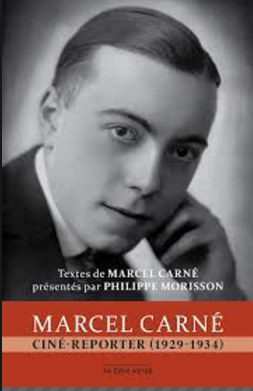
An excellent volume of Marcel Carné's film criticism has just appeared: Marcel Carné: Ciné-reporter (1929-1934), edited by Philippe Morisson and published by La Tour Verte.

One section, entitled 'Cet art qui fut muet et devint parlant: Articles sur les talkies' [That art that was dumb and became talking: Articles on the talkies], includes pieces published in Cinémagazine and other film magazines between August 1929 and April 1931, at the height of the transition from silent to sound films. Carné covers what it is like on a film set shooting a sound picture, discusses the technical requirements and skillsets required to shoot and edit sound film (at a time when the camera was just emerging again from its soundproof booth), and debates with Marcel Lapierre about whether silent film has, in fact, had its day.

One of the pieces, 'De l'internationalité du film parlant' ['On the internationalism of the talking picture'] published in Cinémagazine 48, 29 November 1929, gives a fascinating viewpoint on the development, and unpopularity, of subtitles in France. This is so relevant to my own research on film translation between the silent and the sound periods (see http://www.britac.ac.uk/events/2015/Splendid_Innovations.cfm) that I hope I will be forgiven for quoting it at some length. It is also cited by my colleague Dr Jean-François Cornu in his 2014 book Le doublage et le sous-titrage. Histoire et esthétique (Presses Universitaires de Rennes),

I have taken the liberty of putting a few particularly interesting phrases in bold, including the speculation that talking films might, like great books, one day have translators of their own (gosh!); and the condemnation that subtitling was a cognitive impossibility for audiences. The first of these statements is not false as such; but the low status of film translators relative to literary translators (see this post for more on this) makes it in some ways a slightly skewed prediction.

 The translation that follows, and any errors in it, are my own.
Le seul reproche - il est vrai qu'il est de taille - qu'on puisse adresser aujourd'hui au film parlant, est que du jour où le cinéma a trouvé la parole, il a cessé d'être un art international par excellence.
   Encore faudrait-il s'entendre là-dessus; le cinéma parlant est national au même titre que la littérature ou le théâtre. Et nous verrons tout à l'heure qu'il est fort possible que, d'ici quelque temps, le film parlé, produit d'une race, ait, lui aussi, ses traducteurs, tout comme un chef-d'oeuvre de la littérature ou une pièce consacrée dans son propre pays, par un succès éclatant.
   À l'origine des talkies, on imagina, pour tourner la difficulté, de sur-impressioner sur l'image des sous-titres explicatifs. Au début, la curiosité l'emporta: il nous suffit de citer le succès du Chanteur de jazz et de La Chanson de Paris. Pourtant, ce que les spectateurs toléraient pour les premiers films, ils l'admirent moins facilement par la suite.
C'est ainsi que Weary River, pour n'en citer qu'un, valant très largement les deux premiers, connut un succès honorable, certes, mais ne souffrant pas la comparaison avec ses deux devanciers. Encore plus que l'absence d'une très grande vedette (car Barthelmess, malgré son grand talent, n'a pas la célébrité d'un Chevalier), les nombreux sous-titres français intercalés dans Weary River ne furent pas étrangers à cet état de choses. Il n'est, au reste, pas une personne à l'heure actuelle qui n'ait compris que ce système n'est qu'un pis-aller qui ne saurait subsister bien longtemps encore. Outre que cela est fort désagréable, il est matériellement impossible à un spectateur de suivre à la fois le jeu parlé des acteurs et de lire les sous-titres inscrits dans le bas de l'image.
   Et puis n'est-il pas paradoxal que le film parlant, au lieu de supprimer les sous-titres comme on était en droit de attendre de lui, les multiplie, au contraire, à l'infini?
   Un établissement des boulevards n'annonce-t-il pas actuellement un film parlant américain cent pour cent parlant avec de nombreux sous-titres français; alors qu'une telle annonce eût fait fuir les spectateurs il y a seulement un an! Enfin, les lecteurs de cette revue n'ont pas été sans remarquer que le procédé de surimpression des titres nécessite, ce que l'on appelle en termes techniques, un contretype, c'est-à-dire un double tirage du négatif, ce qui a pour efet d'obscurcir singulièrement la photographie la plus lumineuse.
   Donc, à tous les points de vue, le système s'avérait détestable. Aussi, a-t-on cherché autre chose. Et la lumière nous est venue, cette fois, de l'Angleterre. [...]
My translation: The only reproach - though, to be fair, a substantial one - that could be directed today to the talking film, is that from the moment that cinema discovered words, it ceased to become the international art par excellence.
   Let us be clear: the sound cinema is national in the same way as literature or theatre are. And we will see shortly that it is entirely possible that, some time in the future, the talking film, as a national product, will itself also have its translators, just as a literary masterpiece might, or a theatre play which has been a major success in its own country.
   When talkies began, someone came up with the idea of solving the problem by superimposing explanatory sub-titles on the image. This passed muster with early spectators, as witness the success of The Jazz Singer and Innocents of Paris. But what spectators tolerated in the first sound films was less welcome to them as time went on. That explains why Weary River, for instance, every bit as good as the two earlier films, met with fair success, sure, but nothing like its two predecessors. This will have been partly due to the lack of a major star (because Barthelmess, while a very talented actor, has nothing like Maurice Chevalier's fame), but the many French subtitles in Weary River were also a factor. There isn't anybody, at this point, who hasn't realised that this system [subtitling] is nothing but a shabby compromise whose days are numbered. Apart from the fact that it is very disagreeable, it is materially impossible for a spectator to follow the actors' performances and to read the subtitles at the bottom of the image at the same time.
   And is it not paradoxical that the talking film, instead of suppressing titles as we might have expected, is instead proliferating them into infinity?
   Is a popular Paris cinema not currently advertising a 100 per cent talking American film with many French subtitles, though such an advertisement would have made spectators take to their heels only a year ago! And readers of this periodical have taken the opportunity to observe that the superimposition of titles on the image requires what is technically referred to as a contretype, in other words a duplication of the negative, the result of which is a noticeable darkening of even the brightest photographic image.
   So, on all fronts, the system has proven detestable. Another solution was sought. And the light came, this time, from England. [...]

(c) for the translation Carol O'Sullivan, 2016. Many thanks to Sam B. for picking up a couple of errors in the draft.

Sunday, 22 November 2015

Translating Rome, Open City

I went to a splendid showing of Roberto Rossellini's 1945 film Roma, città aperta on Friday night, courtesy of the Italian Department at the University of Bristol and the InsideArts festival. We saw a restored print with English subtitles credited to the festival Il cinema ritrovato, where the restoration was done.


The film is certainly not the version scorned by one denizen of Netflix for its "Operetta germans, heroic priests, magazine-cover kids, forced conversation, bad (frequently missing!) subtitles, video quality low (all the scratches, blotches, and dark areas are here, just like you're watching the old film)" (one does wonder if the subtitles and the print quality had been better, would the viewer have found the Germans operettish, the conversation forced, etc.)

The subtitles on this version were good and often funny, with smart and unobtrusive solutions for many very Italian turns of phrase. It made me wonder about the first English subtitled version of this film in the US, which opened, according to David Forgacs, on 25 February 1946 at the World Theater on 49th St., and ran there for nearly two years. It had subtitles by Pietro di Donato and Herman Weinberg. Herman G. Weinberg worked as a subtitler and film critic from the early 1930s to the early 1970s and pioneered subtitling in the United States; more on him in a future post, perhaps.

Are di Donato and Weinberg guilty of perpetrating the "bad and frequently missing" subtitles mentioned above? Bosley Crowther in the New York Times doesn't comment. I wonder what the local newspaper files of newspapers.com may be able to tell us.

The Winnipeg Tribune of Friday 18 April, 1947 closes a long review by naming and praising the subtitlers:


In a slightly later review on Tuesday 17 June, 1947, the Sandusky Register in Sandusky, Ohio, comments that
We do, however, get a hint in the Winnipeg Tribune review that these subtitles might have been the rather selective subtitles which were typical of the period. And lo, the Gazette and Daily, of York, Pennsylvania, on 11 February 1947 indeed had some reservations about the completeness of the subtitles: 


The subtitles must have really been quite bad to trigger this return to the 'transcending the limitations of language' shtick, so prevalent fifteen years previously. It looks likely that these subtitles may indeed be the ones referred to so bitterly by the disenchanted Netflixer above.

Interestingly, subtitles still seem to have been rather strange to a proportion of the film-going audience, or why does the Daily Times-News of Burlington, NC have to explain, on 12 July 1947, what subtitles are?:


But the award for the most comprehensive comment on the film's translation (or at least the most comprehensive that a evening's energetic keyword searching could provide) must go to a columnist on the Daily Tar Heel, student newspaper at the University of North Carolina at Chapel Hill, who has this to say on May Day 1947 (I give it in extenso, so that you get the full flavour):


Mr Allen expends much of his creative energies on describing the subtitles:


Setting aside the author's unendearing linguistic shtick, this review gives us a rather clearer picture of how selective Mr Weinberg's and signor di Donato's subtitles really were. It offers an intriguing research line to follow. How much was this viewer exaggerating the selectiveness of the subtitling? To what extent were other reviewers just grinning and bearing it - or, indeed, so riveted by the film's acting and storyline that they did not fully notice the subtitles? Only a close comparison against a copy of this version of the film can begin to tell us.

It becomes clear in the closing paragraphs of the review that Mr Allen's disappointment in Open City stemmed from the mismatch between the advertising and the product:


This seems to have been the kind of advertising that Allen was talking about: 

 From Samuel Wilson's excellent review at http://mondo70.blogspot.co.uk/2010/12/open-city-1945-and-foreign-film.html

Tino Balio's informative book The Foreign Film Renaissance on American Screens 1946-1973 has much to say about the way this film was marketed:
Realizing it would take time to cultivate an audience for foreign films, [the distributor, Joseph] Burstyn used venerable exploitation techniques to attract attention. [...] Although the New York Board of Censors passed the film "with but insignificant scissorings", according to Variety, Mayer-Burstyn decided to bypass the Production Code Administration (PCA) to avoid having to make further cuts. The same article continued: "Its got plenty to make [Hollywood censors] blanch if and when it is shown them. Principal sympathetic femme character speaks openly of her pregnancy, although she's not wed, and the traitoress who leads to the capture and death of the partisans betrays them for a combination of cocaine and the love of a lesbo German spy. That's just a sample of the angles for the PCA to mull, while the handling of the priest will no doubt make the Legion of Decency gulp hard, although the film has been okayed by the Vatican." Unlike the Vatican, the Legion of Decency found much to fault in the film and gave it a condemned rating. Lacking the Production Code seal and the C rating meant that Open City would not be booked by the major theater chains.
The Mayer-Burstyn partnership made the best of circumstances. First, it released Roma, città aperta, the original title of the film, as Open City. The original referred to Rome's protected status during the war as a historical city. Burstyn's title suggests something quite different - a wide-open city where anything goes. In line with this title change, Mayer-Burstyn promoted the film as "Sexier than Hollywood ever dared to be!" and ran ads with fake publicity stills, one showing "two young ladies deeply engrossed in a rapt embrace" and another of "a man being flogged", both of where were "designed to tap the sadist trade", according to Mayer. As Variety explained, two types of audiences existed for foreign films: the "fairly discriminating filmgoers", who were taken with the "raw, unvarnished approach to sex" in the films, and the "transients, the misfits...and the loose-jawed brethren" who normally got their thrills vicariously from exploitation films". At first Open City played in art houses and independent theaters. Mayer-Burstyn later toned down the torture scenes and removed an offending shot of a toddler on a potty to secure a coveted code seal and entrée to mainstream theaters. (pp.41-42)
There's much to mull over here, including the existence of multiple cuts of the film, and the questions that remain over which version of the film a given audience might have seen. I like very much Samuel Wilson's comment, in his review of Balio's book and the film, that the Burstyn-Mayer release is an important version (or, I guess, versions) in its own right, which deserved to be given greater prominence in the Criterion edition. In the same vein, I would argue that di Donato and Weinberg's subtitles, patchy as they were, are also a significant factor in the film's reception in the United States, and deserve to be represented, even in the form of a clip for purposes of comparison, on a future DVD. 

N.B. Post updated after publication to reflect the fact that di Donato and Weinberg's subtitles seem to be available in all their patchiness and elegance of typeface, on the TCM website


Post-post-scriptum: Updated once again on finding out from colleague and Italian film scholar Catherine O'Rawe that Pietro di Donato was in fact a somewhat well-known literary figure. There is an essay by Loredana Polezzi about his novel Christ in Concrete here.

Wednesday, 11 November 2015

The return of the translating dissolve

In my book Translating Popular Film I talked about the device of the 'translating dissolve' which was so common in the 1920s and 1930s. Here's an example from the wonderful Frank Capra film The Bitter Tea of General Yen (1933), with the wonderful Nils Asther in far-from-wonderful yellowface as the eponymous general:


The translating dissolve is also described by David Cairns on his excellent 'Shadowplay' blog, and at more length by R. John Williams in a very interesting and lavishly illustrated article from 2009, 'Global English Ideography and the Dissolve Translation in Hollywood Film'. Cairns uses the example of Daughter of the Dragon (Corrigan, 1931). In my book I argued that the 'translating dissolve' represented a kind of perceptual 'point of view' shot where the viewer gets to see from the point of view of a character who understands the source language:


Odd it may have been, but it was a standard way of making foreign-language written texts 'processable' for American viewers and thus contributed in an important way to linguistic realism in film.

I came across another interesting example this evening leafing through Daisuke Miyao's book Sessue Hayakawa: Silent Cinema and Transnational Stardom, where a translating dissolve from the film The Typhoon (Barker, 1914) proves to be more than it seems (the relevant bit starts at the bottom of page 70):


This underlines how long-lived this particular device was; from the 1910s to the 1930s and beyond. It also made me wonder how early this device was used. I'd be delighted to hear from any readers with earlier examples, or with examples later than the 1930s.

Sunday, 25 October 2015

Silent film viewing in Luxembourg, c.1920

I really enjoyed this post on Luke McKernan's excellent Picturegoing blog, which quotes an account by the American journalist Robert Joseph Casey (1890-1962) of going to the cinema in the town of Ettleburck in Luxembourg shortly after the First World War:
I suspected from the first that “On the Line of the Four,” however much it might promise as a war picture, was very likely our old friend and neighbor “The Sign of the Four,” and so it was.

The original nationality of the piece was a doubtful matter. There was hardly enough of it left to give one a consecutive idea of the plot, and the French captions were so worn that little was to be gained from them. It may have been an American film of that era when there were no stars. At any rate, no latter-day favorites appeared in it. It may have been English. Certain elements in the “locations” suggested England forcibly. But whatever its pedigree, its days of usefulness were nearly done.

The Anglo Saxons in the house, to whom the name Sherlock Holmes was a sufficient guaranty of story action and plot, could not get very far with the titles in French. Those who had mastered enough of the language to surmount this difficulty were certain to become hopelessly muddled in the aimless mixing of scenes that seemed to be the result of many years of “cut and patch.”
This issue of the difficulty of identifying a silent film's origin echoes the story of the 'O'Kalem collection', a DVD release of the surviving films shot by the Kalem film company (in its various incarnations) in Ireland between 1910 and 1915. The fact that two of the films, The Lad from Old Ireland (1910) and His Mother (1912), only survived in German and Dutch versions respectively, 'delayed their identification by scholars over the years', as we are told in the very informative booklet accompanying the DVD.

Wednesday, 29 July 2015

Snippets from film translation history: the subtitle turners

Following on a very interesting paper by Rachel Weissbrod at the Splendid Innovations conference in May 2015 at the British Academy, where Rachel talked about the beginnings of film translation in Mandatory Palestine, I have been reminded by Sam B. of this story by Israeli film producer Menahem Golan, from an interview in Cinema Scope:


Cinema Scope: You became involved with movies as a child back in your Israeli hometown of Tiberias, when one of your first jobs was as a subtitle-turner.

 Menahem Golan: At that time the subtitles were not on the film, but projected on the side. So you needed someone to turn the wheel. And already as a child I wanted to see every movie, but my father didn’t give me the money to go to the cinema three or four times a week. So I made a deal with the projectionist that I would turn the film subtitles for free, as long as I could see the movie. But it often happened that I got so caught up in the film that I forgot to turn the wheel. And the whole cinema would start yelling: “Menahem! Menahem! Subtitles!!!”

UPDATE 21 August 2015: I have just come across this account on Luke McKernan's excellent Picturegoing blog by the Palestianian author Khalid Totah (1886-1955) of going to see Olivier's Hamlet and another unnamed Hollywood film in Damascus, probably in the late 1940s. There's just a brief mention of the subtitles: 'of course the film was in English, but on the side there was an Arabic translation'. This would have been a bit later than Golan's account - Golan was born in 1929, so was probably turning subtitles in the early 1940s. If any readers know of other accounts of this subtitling-on-the-side in the Middle East I'd be very happy to hear about it.

Saturday, 11 July 2015

"Sub-titles inept, sub-titles abominable": a Russian film in the UK, 1935

I made a long-awaited trip back to Southsea this weekend and popped in to my favourite bookshop in the world, Adelphi Books on Albert Road, where I acquired (among other trifles) some 1930s issues of Sight and Sound. The autumn 1935 issue contains a review by Arthur Vesselo of Petersburg Nights (Roshal & Stroyeva, 1934) (referred to in the review as St. Petersburg, known in France as Les nuits de Saint-Pétersbourg). (I note that the film was nominated in the same year for the Mussolini Cup for Best Foreign Film at the Venice Film Festival, but otherwise seems to have had an undistinguished career.)

(image borrowed from Encyclocine)

Vesselo isn't happy with the film, or the translation:
The film as a whole has little real solidity: its movements are feeble, its climaxes crude. The propagandist element lacks both purpose and subtlety, and the nineteenth-century setting is infinitely less convincing than the customary Russian treatment of present-day conditions. What virtue remains is ruthlessly massacred by the sub-titles.
   This question of sub-titles needs long and deep consideration. They meet us at every turn: sub-titles misplaced, sub-titles mis-spelt, sub-titles inept, sub-titles abominable. They throw out the composition of shots, ruin their photographic quality, and break up their continuity - sometimes they seem to swamp the picture completely. (Sight and Sound 1935, vol. 4, no.15, p.124)
There were very competent subtitlers working in London in this period - Mai Harris, Julia Wolf - so one suspects that these abominable sub-titles may have been produced in the country of origin - well, we'll see, if a copy can be tracked down in the archive.

It's worth noting by the by that Vesselo doesn't seem a big fan of dubbing either: in the same section he reviews a Czech film, Volga in Flames, and complains that the dubbed English dialogue
was hardly a success. the lack of correspondence between words and mouth-movements can be ignored, but the vast unsuitability of Western tone and accent is another matter. Cossacks and Cockneys have little in common; and at moments of tension the formal intonation of the studio reduces the action to bathos. Choice of language also provides its problems. Wherever, in fact, the dialogue ceased for a space to be predominant, and the film was left to rely upon its original sounds, the story was lifted bodily to a higher sphere.
Interestingly,  Vesselo doesn't note that the film was in fact dubbed from French (thanks to Sam B. for pointing this out) as the film was a French-Czech co-production with Danielle Darrieux and Albert Préjean, also known as Volga en flammes:


Tuesday, 19 May 2015

Adrian Brunel redux: on subtitling and dubbing in the early 1930s

I mentioned Adrian Brunel's autobiography Nice Work in a recent post, as he observed the transition from the silent to the sound period from close up. On reading further we learn that he also worked as a subtitler some time in the early 1930s.

It is not very promising that the chapter where he describes his work in audiovisual translation is entitled 'Slumming':
I picked up a few little interesting jobs titling foreign films - interesting as jobs but deadly dull financially. After having been paid £250 for titling a silent foreign film, the maximum I could get for doing a foreign talkie was £40. As I [...] naturally gave part of my fee to Roy Lockwood, Reggie Beck or whoever was assisting me, it was hardly worth our time after we had learned what we could of the job. One think I learned still applies to-day [at time of writing in the late 1940s] - that the super-imposition of translated titles is a neglected art, probably because it is very badly paid. Most foreign film so titled are spoiled by not having had enough time, invention and skill expended on grappling with the problem of condensing eighteen spoken words into six printed words, of finding just the right place to superimpose the title, of judging when no title is necessary, of how to avoid unnecessary overlapping of a title on to two scenes and so on. (p.162)
It's interesting to see how little the basics of subtitling have changed in nearly a century, though subtitles were sparser and more selective, still, at the time Brunel was writing. Brunel himself felt that dubbing was superior to subtitling: 'superimposed translations [were] disturbing', while 'with care, patience, time and intelligence, almost perfect results can be obtained' in dubbing. He was involved in dubbing the Guido Brignone film La Wally, made in 1932, but found that the translation did not go far enough:
we did a fine job [...] but unfortunately my detailed and urgently stressed advice on how to edit the film for England was ignored, so that it was ruined by the inclusion of several passages which I knew would be regarded as ridiculous by English audiences. (p.165)
If you are interested in hearing more about these problems of audiovisual translation in the early years of sound, you may still (just about) be able to register for our conference 'Splendid Innovations', which takes place this Thursday 21 and Friday 22 May at the British Academy, London:


Only two more sleeps until the conference! \o/\o/

Saturday, 25 April 2015

Less than a month to go! "Splendid Innovations" conference on film translation history

We're getting very excited that our conference on the history of film translation is only weeks away! (21 and 22 May, to be precise). The conference is very generously funded by the British Academy and features distinguished archivists, film historians and translation scholars from many parts of the world.

Registration is still open via the conference website at http://www.britac.ac.uk/events/2015/Splendid_Innovations.cfm. Registration runs via the website until 11 May, and thereafter by email, but places are limited.

Please feel free to download and circulate this e-flier to anyone who may be interested.


Tuesday, 21 April 2015

"Consultants and doctors for sick films": snippet of film translation history


I have been reading and greatly enjoying Adrian Brunel's autobiography Nice Work, about his early career in silent films and then on into sound films. I'm particularly interested in the editing work he did on silent films, which relates to our forthcoming conference at the British Academy: Splendid Innovations: The Development, Reception and Preservation of Screen Translation.

(Thanks are due to Robert Smith of Adelphi Books, Southsea, for selling me the book some years ago and to Mark Fuller of Bristol Silents for recommending it and galvanising me to go and take the book off the shelf).

In the late 1920s Brunel went into business with Ivor Montagu, co-founder of the Film Society, table-tennis player, filmmaker, conservationist and translator, to edit silent films that weren't quite geared for a British audience. They offered their services, as Brunel put it, 'as consultants and doctors for sick films':
Numbers of foreign films were being imported which failed to appeal to British audiences because of certain remediable 'defects', and after we had very successfully operated on a few of them, Wardour Street began to realise the value of my little unit of editors.
   When the Film Society began importing films, editors were required, and so Ivor used my cutting rooms and my staff. After a time we formed a company, Brunel and Montagu, for editing films - the only one of its kind in the world - and were soon known in the trade as Brunel and Montage. As our business was almost entirely confined to the treatment of completed films with which there was something wrong, we discreetly omitted our names from the credit titles of the majority of those films which passed through our hands; but for this fact, ours would have become a household name in all cinemas, for not only was the volume of our business considerable, but we dealt with many of the most famous films of those days.
   The variety of our work was one of its many attractive qualities. [...] Next week's film might be American, Burmese or Japanese; it might be a spy drama, a village comedy or a medical instructional film. Again, anything might happen in connection with the work; one of us might have to go to Berlin, Rome, or Paris; or F.J. Perry, the tennis champion, might call in for a game of table tennis with Ivor, his coach; or we might have a sudden trade-show job, requiring three or four of us to go down to a film studio and work on the editing of a film for forty-eight hours before going to bed; or an importer of foreign films might call upon us to get passed by the Censor some rather risky and valueless picture, promising us a percentage of his huge (estimated) profits but having no cash to pay us for our work.  (Brunel, Nice Work, pp.117-8)
This business collapsed with the advent of the talkies, because, as Brunel says ruefully, 'it was impossible then to persuade film people that talkies needed any kind of constructive or creative editing or even that editors could do anything to adjust defects in synchronised films - editors were relegated to the position of film joiners, defeatists who accepted what they got and just assembled it' (p.122).

I was interested to see that one of the films he was involved with was G.W. Pabst's Kameradschaft (1931), one of my favourite films, and the first film in England, as far as I know, to be exhibited with superimposed titles:
I remember [the British Board of Film Censors] objecting to a scene in that magnificent film "Kamaradschaft" [sic], a distant shot of a number of naked miners bathing. It was a very pleasing scene from the point of view of composition, and from what one could see, through the steam, the men were fine specimens and were most skilfully manoeuvred so as not to alarm those unfortunate people who have peculiar ideas about the human body; it was interesting and, to me and my colleagues, completely unobjectionable. When I was told by the B.B.F.C that this scene must be cut out of the film I protested and pointed out that it had been shown in every civilised country in Europe. "On the Continent- yes, they would!" said one of the censors. I persisted. The B.B.F.C. officials then professed to be surprised and shocked at my attitude. "Surely you wouldn't wish little boys and girls to see revolting scenes of naked miners?" one of them who had not seen the film asked. They were adamant and so the scene had to come out. [...] However, this was only one scene; it was a pity to lose it, but it didn't ruin the film to cut it out. (Nice Work p.121)
It's interesting that Brunel mentions this, because it was a sound film, and yet apparently it didn't come under the heading of films which could not be improved through editing. The scene to which the eager beavers of the B.B.F.C. objected can be seen at 31:20 in the copy of Kameradschaft available on Youtube:


To go directly to the scene in question, click here.

The viewing copy I've seen at the British Film Institute, which is, as far as I am aware, a copy of the UK release print from 1932, shows that the film had added pictorial credits at the beginning, as well as the innovative subtitles. Were these the work of Brunel and Montagu as well? Can we ever know? And should we consider the absence of footage of naked miners part of the film's 'translation' to the UK? Come along on 21 and 22 May to find out....


Credits: 

The 'Splendid Innovations' conference, co-organised by me and the subtitler, translator and historian Jean-François Cornu will take place on 21 and 22 May, 2015 at the British Academy in London. It will be accompanied by a free public performance by the distinguished Japanese benshi, Kataoka Ichiro, with Japanese film scholar Professor Markus Nornes and with live music by Cyrus Gabrysch.

Bristol Silents is a group of extremely nice and knowledgeable enthusiasts who curate some of the best silent film events in Britain and are a big part of what makes Bristol a great place to be a film nerd.

Adelphi Books is my favourite shop in all the world. It doesn't have a website - it has to be experienced in person. Its owner Robert Smith has introduced me to many of my favourite films of the 1920s and 1930s. 

*****

UPDATE 27 APRIL 2015:

I wonder a bit about this distinction that Brunel draws between silent films which could freely be recut and sound films which didn't lend themselves to editing. Lucy Mazdon and Catherine Wheatley, in their excellent book French Film in Britain, Sex, Art and Cinephilia, quote a 1939 piece by Yvonne Thomas in Sight and Sound as saying that
The only bother with [Continental films] in those days [the silent period] was that from a English audience's point of view, they were far too long. They invariably had to be cut to meet our own requirements, but these cuts could usually be made without detracting from the story.
This certainly supports Brunel's account, but then Brunel also brings in the sound film Kameradschaft. And Joan Hills' obituary of the distinguished subtitler Julia Wolf, who subtitled every foreign film at the Curzon from its opening in 1934 to its closure due to bomb damage during the Second World War (Mazdon & Wheatley pp.27-8), suggests that she recut not only silent, but also sound films - sometimes, as Brunel did, as a way of 'managing' the censorship process. [totters off to do more reading]

Wednesday, 18 March 2015

Jean-François Cornu, film translation researcher, translator, subtitler

We are delighted to announce a visit to Bristol by Dr Jean-François Cornu, distinguished researcher in film translation, translator and subtitler.


Dr Cornu will give two talks. The first is a research seminar:

Principles for a historiography of film translation

Tuesday 24 March 2015

University of Bristol, Woodland Road, BS8
Arts Complex LR8, 5.15-7pm
(Entrance for external visitors via 3-5 Woodland Rd)
There is film history, and there is translation history. But is there such a thing as film translation history? Whether we call it film translation, screen translation, or audiovisual translation, this particular form of translation does have a history, which remains largely unexplored to this day.
This talk will try to define what film translation is, when it started, whether it belongs to any existing field of research or is a field in its own right. It will include a number of film clips and will suggest some principles for a historiography of film translation. 

The lecture will be delivered in English. Followed by a glass of wine! All welcome.

The second talk is entitled:

Aesthetics and the nuts and bolts of subtitling

This session will use film clips to focus on practical subtitling issues including layout and the relationship between subtitles and the other codes of the film.

Wednesday 25 March
43 Woodland Road, LR2, 12 noon-1pm

Dr Jean-François Cornu is a professional translator specialising in subtitling and the translation from English into French of books on cinema and art. A former Senior Lecturer at the University of Rennes-2, France, he is now an independent film researcher. In 2014, he published the monograph Le doublage et le sous-titrage: histoire et esthétique [Dubbing and subtitling: history and aesthetics] (Presses universitaires de Rennes). He is a co-editor of the e-journal L’Écran traduit.
For more information on Dr Cornu, please see this filmed interview in the Journal of Specialised Translation. 

The 'speech-man': Screen translation and the benshi tradition in Japan

We are very excited about our upcoming conference on 'Splendid Innovations' in the history of film translation, focusing on the 1920s and 1930s and the arrival of sound. We have an extraordinary international line-up of speakers: for the full list, or to register, click here.

Alongside this event, we are delighted to be featuring an open evening showcasing the Japanese tradition of the benshi, or film narrator. Benshi performed alongside the film, and were big stars in Japan in the silent period. Here's a mention of the benshi from an American newspaper report of 1927:

 Snippet from the Lincoln Star, 10 July 1927, from newspapers.com.

(I should say that despite the phrase 'speech-man' benshi are not only men - for instance, the distinguished benshi Midori Sawato). There are some more details about the work of the benshi here. See also Markus Nornes' wonderful book Cinema Babel: Translating Global Cinema.

Our benshi is Kataoka Ichiro, a distinguished performer who has taken part in film screenings around the world. You can find more information on Mr Kataoka's background here. The event will also feature Professor Markus Nornes, a specialist in Japanese cinema as well as author of some of the most interesting work on audiovisual translation. Mr Kataoka and Professor Nornes will present narration for short films from Japanese and English, and there will be an opportunity for questions and answers. For more information, here is a clip of Mr Kataoka performing:


The event is designed to be accessible for non-Japanese speakers, though Japanese speakers are of course warmly welcome. Feel free to circulate the flyer below to anyone you think might be interested. To register for this event, see the event webpage here. The event is free, but registration is required.


Sunday, 1 March 2015

Missing the joke? Hellzapoppin! in translation

I'm excited about taking part in the upcoming 'Authors and the World' workshop in Lancaster on Discourses of Literary Celebrity Across Genres (see here for more information). I'll be talking about literary celebrity and subtitling, which are two things that don't really seem to go together.

Well, nearly never. Every now and then, a subtitler makes a name for themselves, like Mai Harris, Herman Weinberg, Linda Hoaglund or Lenny Borger. There is even the rare 'celebrity' subtitler like Anthony Burgess for Rappeneau's Cyrano de Bergerac. When the 1941 Universal comedy extravaganza Hellzapoppin was released in France after the end of the Second World War, it was advertised as a 'version originale sous-titrée par LES ROIS DES LOUFOQUES Pierre Dac and Fernand Rauzéna'. Dac was a comedian who broadcast for the French resistance from Radio Londres during the war. Fernand Rauzéna was an actor whose work included dubbing Stan Laurel and who worked with Dac on the Société des Loufoques radio show in the second half of the 1930s.


(Thanks (again) to Sam B. for pointing this one out). As you can see from the poster, the French subtitler writers' names are bigger than those of the film's stars.

I haven't seen a French version of this film yet, but I'm curious to see how they manage the zany humour of the original film. ("May I take your picture?" says a keen photographer, before removing a framed canvas from the wall and running off with it.) Unfortunately, as I understand it, the DVD of the film released in France doesn't have these much-trumpeted subtitles, but a well-received new subtitle translation by Michelle Nahon.

I do, however, have an Italian dubbed version of the film and I can see already that some of the humour seems to have dissipated in translation. (For one thing, the whole sequence containing the line quoted above has disappeared in the television broadcast version I have so I can't see how they would have done that in Italian.) My current project focuses on written text on screen, so I'm most interested in the credits, insert shots etc. The English credits for Hellzapoppin' finish with a devil (seen below in the far left of the image) pulling down a title card saying:


The camera then zooms in on the card and the film's title. In Italian this insert is reshot, but as is fairly standard when inserts are reshot in translation, instead of reproducing the sequence they simply provide the text, superimposed on the same background as the rest of the credits. Alas, the Italian translators (not credited anywhere on my copy) don't seem to have read the text very closely: the Italian text is a standard disclaimer of the type "any similarity with actual persons, living or dead, is purely coincidental".


(Screenshots prepared by the indefatigable Sina Stuhlert, to whom all thanks.)

For a longer preview of what I'll be talking about in Lancaster (with added stats!) see here.